Trump 2.0's Vision for the Western Hemisphere
Suguru Osawa (Associate Professor, Faculty of Letters, Aichi Gakuin University)


The Research Group on the US 2026-# 1
“Research Reports” are compiled by participants in research groups set up at the Japan Institute of International Affairs, and are designed to disseminate, in a timely fashion, the content of presentations made at research group meetings or analyses of current affairs. The “Research Reports” represent their authors’ views.
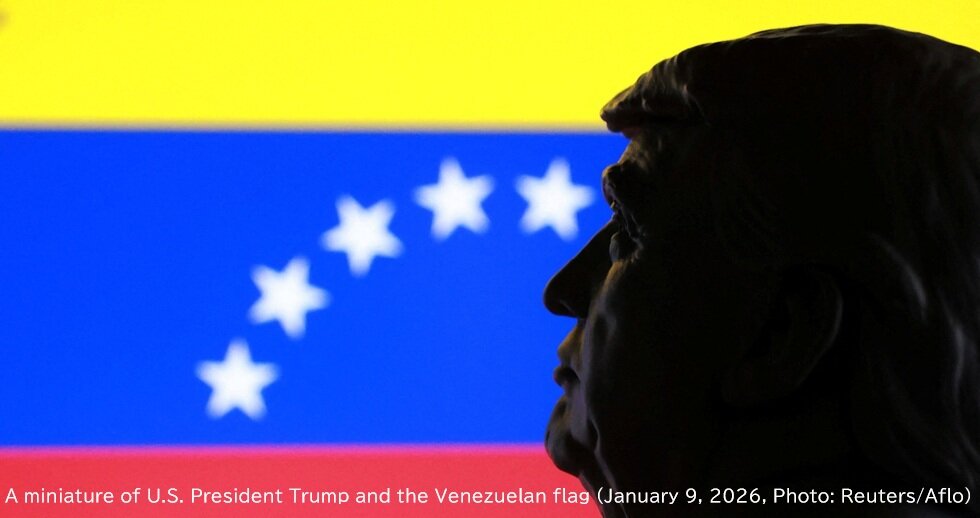
The United States’ hardline actions toward Venezuela came as a surprise to the world. At first, attention focused on attacks on “drug-trafficking vessels” but, shortly after the new year began, the United States announced an attack on Venezuelan territory itself and the detention of President Nicolás Maduro and his wife.
The United States’ stance toward Venezuela appears to underscore the increased emphasis on the Western Hemisphere in the National Security Strategy (NSS) released in December 2025. Given that the United States has scaled back its engagement with Latin America since the 2000s, this “shift” is particularly noteworthy.
What, then, is the future of the Western Hemisphere envisioned by the Trump administration? This paper seeks to examine how the shift articulated in the NSS and the current posture toward Venezuela can be explained within that broader vision.
Contents of the new National Security Strategy
The National Security Strategy (NSS) released during Donald Trump’s second term emphasizes engagement with the Western Hemisphere more strongly than those formulated by previous administrations. The order in which regions appeared in the first Trump administration’s NSS (hereafter NSS 2017) placed the Western Hemisphere fifth—following the Indo-Pacific, Europe, the Middle East, and South and Central Asia (with Africa sixth and last)—and the discussion thereof amounted to only one page. While the document noted China’s growing influence in the region as well as China’s and Russia’s support for Cuba and Venezuela1 , its approach remained abstract.
In the 2022 NSS released by the Biden administration, the Western Hemisphere appeared third, after the Indo-Pacific and Europe, but was still allocated only two pages. As suggested by the section title “Foster Democracy and Shared Prosperity in the Western Hemisphere”, the focus was largely on solidarity grounded in democratic values prioritized by the administration at the time (as well as on responses to COVID-19). 2
By contrast, the Western Hemisphere appears before any other region in the NSS released last December by the second Trump administration (hereafter NSS 2025) and is allotted approximately four pages under the subtitle “Western Hemisphere: The Trump Corollary to the Monroe Doctrine”.
At the beginning of the section, the document states: “After years of neglect, the United States will reassert and enforce the Monroe Doctrine to restore American preeminence in the Western Hemisphere, and to protect our homeland and our access to key geographies throughout the region. We will deny non-Hemispheric competitors the ability to position forces or other threatening capabilities, or to own or control strategically vital assets, in our Hemisphere. This “Trump Corollary” to the Monroe Doctrine is a common-sense and potent restoration of American power and priorities, consistent with American security interests.” Unlike in the past, this language evokes the prospect of active intervention in the region.
To achieve these objectives, the United States advances two guiding concepts: “enlist” and “expand.” “Enlist” refers to building partnerships to strengthen immigration control, counter-narcotics efforts, and security and stability on land and at sea, while “expand” emphasizes cultivating new partners in the region and positioning the United States as the preferred economic and security partner.
Under “enlist,” the NSS notes the need to reconsider the U.S. military presence in the region, including: (1) withdrawal from theaters of declining relative importance in order to address threats to the Americas and rebalance the U.S.’ global military posture; (2) appropriate Coast Guard and Navy deployments to interdict illegal migration, human trafficking, and drug smuggling, and to control key transportation routes in times of crisis; (3) focused deployments – and, where necessary, the use of force – to stabilize borders and dismantle cartels, as alternatives to legal process–based strategies that have failed over recent decades; and (4) efforts to expand and secure access to strategically important areas.
Under “expand,” the NSS argues that, given the involvement of external competitors in the Western Hemisphere, maintaining U.S. preeminence in the region is a prerequisite for American security and prosperity. To this end, it establishes reducing the influence of hostile external actors as a condition for cooperation and the provision of any form of assistance.
The scope of concern ranges widely, from control over military facilities, ports, and critical infrastructure to the acquisition of strategic assets in a broad sense.
The document further asserts that the United States should leverage its financial and technological influence to encourage countries to reject extra-regional support, promote the superiority of U.S. products, services, and technologies, and work with Latin American governments and companies to protect U.S. interests. It also presents countries with a stark choice: to live in a world of sovereign states and free economies led by the United States, or in a world shaped by the influence of countries on the other side of the globe.3
Key features of the new National Security Strategy
Two aspects of NSS 2025 are particularly noteworthy. First, it places strong emphasis on immigration control and counter-narcotics – issues long prioritized by President Trump – while incorporating a distinctly military perspective. Second, it clearly seeks to constrain China’s expanding presence in Latin America while avoiding explicit references to China. Also worth noting is that immigration management appears at the very top of the “Priorities” list in the Strategy chapter.
During the first Trump administration, U.S. policy toward Latin America likewise focused on immigration and drug-related issues, with attention primarily directed toward North and Central America and the Caribbean, regions with the most direct impact on the United States. Venezuela, too, can be understood within this framework: given its maritime proximity to the United States, policy toward Venezuela falls under the rubric of homeland security, making it particularly resonant with Trump’s political base. In this sense, the future of the Western Hemisphere envisioned in NSS 2025 closely aligns with the preferences of the administration’s supporters.
Another novel feature of NSS 2025 is its clear – albeit indirect – effort to counter China’s advance into Latin America. This contrasts with NSS 2017, which explicitly mentioned Chinese (and Russian) involvement in the Western Hemisphere but offered only abstract responses. In other words, while NSS 2017 named China directly without proposing concrete measures, NSS 2025 blurs the identity of the competitor yet lays out specific steps to enhance U.S. presence in the region.
Since the 2000s, the United States has consistently deprioritized Latin America, driven in large part by its focus on the global war on terror. This tendency has largely held regardless of whether Republicans or Democrats were in power. It was this strategic vacuum that a rising China moved to fill. Over the same period, China steadily deepened its engagement with Latin America, and in 2017 began to include the region as a “natural extension” of the Belt and Road Initiative. Continuing its engagement amid U.S. indifference, China has now surpassed the United States to become the principal trading partner of several major Latin American countries. Moreover, Chinese ownership of transportation infrastructure such as ports, along with the diffusion of information and communications technologies, has emerged as a security concern for the United States. China has also expanded its involvement in regional organizations such as the Community of Latin American and Caribbean States (CELAC) and deepened military exchanges. As a result, China’s presence in Latin America has advanced across political, economic, and military domains.4
Yet neither the first Trump administration nor the Biden administration demonstrated particularly strong interest in Latin America. The shift in posture under the second Trump administration marks an important turning point.
What does Trump’s version of the Monroe Doctrine (“Donroe Doctrine”) seek to achieve?
Senior government officials made statements endorsing the Monroe Doctrine even during the first Trump term, which saw Trump visit Latin America only once – to attend the G20 summit in Buenos Aires.
That said, the administration took a hard line when it came to U.S. interests, including imposing severe sanctions on anti-U.S. leftist governments such as those in Cuba and Venezuela, renegotiating the North American Free Trade Agreement (NAFTA), and intervening in the Inter-American Development Bank.
At the time, concerns were also growing about China’s involvement in Latin America, particularly in the information and communications technology sector. In 2020, the United States announced the “Clean Network” initiative aimed at excluding Chinese companies from countries in the region. However, Trump failed to secure re-election.
Under the subsequent Biden administration, Latin America was described not as a “backyard” but as a “front yard,” and policies emphasizing democratic values and equality were pursued. Values-based diplomacy that failed to take regional contexts into account proved ineffective, though, and the administration was unable to win over Latin American countries.5
It was against this backdrop that the second Trump administration set sail. Soon after taking office, President Trump sent Secretary of State Marco Rubio on a tour of Central America and the Caribbean, seeking to eliminate Chinese influence over the Panama Canal.
This was followed by attacks on Venezuelan “drug-trafficking vessels” and, subsequently, the detention of the country’s president. Since 2019, the United States had refused to recognize the Maduro government, which inherited anti-U.S. authoritarianism from President Hugo Chávez. Upon Maduro’s detention,
Trump stated that the United States would “run” Venezuela until regime change was achieved.
It is noteworthy that when Trump himself speaks about Venezuela, references to U.S. economic interests – particularly oil – stand out more than appeals to values such as democracy. Comparisons have been drawn between the invasion of Venezuela and the U.S. invasion of Panama at the end of 1989, but the Trump administration’s intervention in Venezuela this time may be aimed less at stabilizing the country through democratization than at curbing the inflow of drugs while securing access to resources.
From this perspective, Trump’s version of the Monroe Doctrine prioritizes justifying forceful engagement with countries affecting U.S. homeland security and economic interests over managing the Western Hemisphere on the basis of shared values. In that sense, the essence of Trump’s foreign policy – an unvarnished pursuit of national self-interest 6 -- has not changed since Trump 1.0. If anything, this tendency has become more pronounced under Trump 2.0. The use of force against Venezuela carried out in this context can thus be understood as both a denunciation of past administrations’ policies as “failures” and, despite internal debates, an action designed to appeal to Trump’s political base.
Future outlook
This paper has examined the Trump administration’s policy toward the Western Hemisphere through NSS 2025 and U.S. involvement in Venezuela. At present, Trump’s version of the Monroe Doctrine can be understood as a guiding principle for forcefully advancing intervention in the Western Hemisphere based on U.S. national interests. In this respect, it echoes the moment in 1904 when President Theodore Roosevelt modified the original Monroe Doctrine – initially intended to reject European interference in the Americas – through the “Roosevelt Corollary,” thereby justifying U.S. intervention in the region.7
The military intervention in Venezuela has split the international community into countries that criticize the United States, those that support it, and those that have not taken a clear position. Given that China and Russia have criticized the United States, and considering their close ties with Venezuela, some observers view the issue as evidence of a world dividing into opposing camps.
However, Latin American countries’ attitudes toward the United States are far from uniform. As illustrated by the Dominican Republic’s decision to postpone the Summit of the Americas that had been scheduled for last December, many Latin American countries harbor deep mistrust toward Washington’s hardline regional posture. 8 While some governments such as President Nayib Bukele’s administration in El Salvador and President Javier Milei’s government in Argentina seek to maintain power by aligning themselves closely with the Trump administration, most Latin American countries attempt to leverage U.S.–China rivalry to their own advantage. More broadly, Latin American states tend to resist U.S. interventions that undermine regional autonomy, and in practice many initiatives that Washington has sought to push through forcefully have faltered. In light of this, it remains unclear whether U.S. “management” of Venezuela, or Trump’s version of the Monroe Doctrine more generally, will succeed. Although NSS 2025 expresses confidence in the strength of ties between the United States and Latin American countries, there is also the view that the Trump administration’s coercive interventions may accelerate closer relations between Latin America and China. 9 China’s presence in the region has become far more pronounced than in the past.
Originally, the Monroe Doctrine functioned both as a warning against European involvement in the Western Hemisphere and as a declaration of non-interference in Europe. NSS 2025 states that “the days of the United States propping up the entire world order like Atlas are over.” If Trump’s version of the Monroe Doctrine, like the original, implies restraint from engagement beyond America’s sphere of influence, Japan would face serious challenges. Whereas NSS 2017 explicitly identified Chinese inroads into the Western Hemisphere as a concern, NSS 2025 refrains from doing so 10 and instead refers to a rebalancing of the global military balance of power. This may suggest that Trump 2.0 is contemplating a vision in which responsibility for managing the international order is effectively demarcated vis-à-vis China.
(January 6, 2026)