- #Security
- #Europe
- #JIIA Strategic Comments
- #Disarmament / Non-proliferation
- #Science and Technology
- #CDAST
- #Center for Disarmament, Science and Technology (CDAST)
JIIA Strategic Comments (2026-7) “Forward Deterrence” and the New Age of France’s Nuclear Deterrence
Timothée Albessard(Special Research Fellow, The Japan Institute of International Affairs. Graduated from The École Normale Supérieure (ENS) in Paris, France)


Papers in the "JIIA Strategic Commentary Series" are prepared mainly by JIIA research fellows to provide comments and policy-oriented analyses of significant international affairs issues in a readily comprehensible and timely manner.
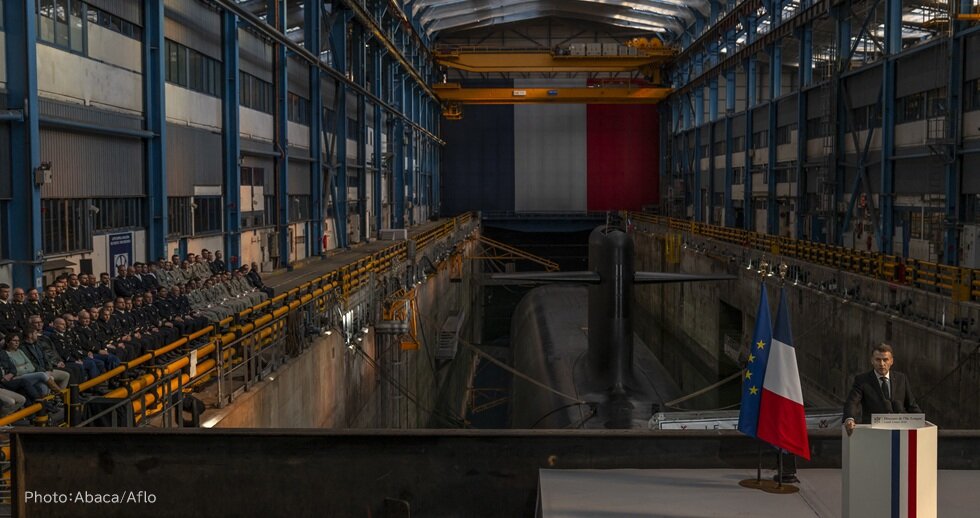
On March 2, French President Emmanuel Macron delivered a much-anticipated address on France’s nuclear doctrine at the Île-Longue naval base, home to the country’s nuclear-capable submarines (SSBNs). Each French president traditionally delivers such a speech during his or her term in office, setting out the core principles of France’s nuclear deterrence. The profound transformations in the European and global strategic environment since President Macron’s previous address in February 2020 have prompted the most significant doctrinal shift in French nuclear deterrence since the end of the Cold War, which, as this article argues, carries substantial implications not only for European security but also for the broader global nuclear order
The dramatic shifts in the strategic and nuclear environment
The first major shift in the strategic environment since the previous speech is Russia’s full-scale invasion of Ukraine, described in the 2025 National Strategic Review as “the most direct threat” to France and Europe. In addition, Russia’s development of new nuclear capabilities (such as the nuclear-powered, nuclear-capable Burevestnik cruise missile and Poseidon torpedo) has further compounded this instability. President Macron also referred—echoing American concerns—to Russia’s alleged plans to deploy nuclear weapons in space, underscoring the increasingly multi-domain character of nuclear competition.
The speech also addressed China’s nuclear buildup more forcefully than previous statements, describing it as a “vigorous effort to catch up with the United States.” This formulation appears to echo, albeit implicitly, U.S. assessments that China is seeking parity with the United States. Unlike Russia, however, China is not portrayed as a direct threat to France or Europe. Rather, it is situated within the broader context of a potential conflict “in the Far East” (Taiwan was not explicitly mentioned).
Cross-regional nuclear dynamics are addressed more directly than in 2020, with explicit reference to the expansion of the nuclear arsenals of India, Pakistan, and North Korea. In this context, President Macron raised questions about the potential consequences of cooperation between Russia and North Korea, as well as the growing alignment between China and Russia. Unlike in U.S. strategic discourse, the possibility of opportunistic aggression—whereby one of these states might exploit a crisis in one theater to advance its interests through aggression or a fait accompli in another—is not discussed, which reflects the still limited integration of cross-regional dynamics into French nuclear deterrence thinking.
Regarding the United States, President Macron acknowledged that it continues to play a “key role in Europe’s defence” through NATO’s extended nuclear deterrence arrangements. At the same time, he referred to the recent National Security Strategy and National Defense Strategy, which identify the defense of the U.S. homeland and the Western Hemisphere as Washington’s top priorities, as well as to repeated U.S. calls for greater European responsibility for its own security. While the credibility of the U.S. commitment was not directly questioned, the underlying message clearly points to the need for increased European engagement to hedge against its unreliability. In this respect, it echoes President Macron’s long-standing advocacy of greater European “strategic autonomy”, as well as enduring French doubts—dating back to De Gaulle—about the durability and credibility of U.S. security guarantees for Europe.
Finally, President Macron identified as the last major component of the shifting strategic context the erosion of the international order and arms control architecture over recent decades. He cited the collapse of the ABM, INF, and New START treaties, Russia’s de-ratification of the CTBT, the potential resumption of nuclear testing, and China’s refusal to enter any kind of talks. This led to his stark conclusion that “the field of rules has turned into a field of ruins”, compelling France to adopt a firmer stance regarding its nuclear doctrine and arsenal.
The reaffirmation of the foundations of French nuclear doctrine and the expansion of its capabilities
In this context, President Macron reaffirmed several core tenets of France’s nuclear doctrine, starting with the unequivocal reaffirmation of presidential resolve to use nuclear weapons: “I will never hesitate to make decisions that are essential to protect our vital interests. If we had to use our arsenal, no State, however powerful, could shield itself from it.” Determination to use nuclear weapons, clearly communicated, is a central pillar of deterrence, alongside capabilities.
The speech further underscored this credibility by emphasizing, in unusually concrete terms, the destructive power of France’s nuclear forces: “Just one of our submarines, like the one behind me, carries firepower equivalent to the sum of all bombs that fell on Europe during the Second World War. That’s close to a thousand times the power of the first nuclear bombs.” By invoking such historical and quantitative comparisons, Macron moved beyond abstract references to “unacceptable damage” and offered a vivid illustration of the scale of destruction involved. The expression “unacceptable damage”, traditionally a cornerstone of French nuclear doctrine, has been replaced by the more indeterminate and arguably more ominous formulation “damage that they [France’s adversaries] could not recover from.”
This rhetorical shift is not insignificant. The notion of “unacceptable damage” historically implied a threshold calibrated to the adversary’s cost-benefit calculations, consistent with France’s deterrence logic: the threat of inflicting losses so severe as to outweigh any conceivable gains. By contrast, the expression “damage that they could not recover from” suggests something closer to irreversible devastation. The reference to the submarine physically positioned behind him during the speech—together with the announcement that France’s future SSBN, scheduled to enter service in 2036, will be named The Invincible—reinforced the credibility of the message, visually linking declaratory policy to operational capability. In doing so, the speech combined political resolve, institutional authority, and tangible military power—three interlocking components that together sustain the credibility of France’s nuclear deterrence.
That credibility is further reinforced by an explicit appeal to the democratic legitimacy underpinning France’s nuclear deterrence. As President Macron stated, “as President of the Republic, elected by direct universal suffrage, I am its guarantor.” By invoking his electoral mandate, he underscores that ultimate authority over nuclear deterrence rests with a head of state chosen directly by the French people. Delivered a little over a year before the next presidential election, the statement also carries a subtle political resonance. It reminds domestic and international audiences that both the daily implementation of deterrence policy and the potential decision to employ nuclear weapons are exercised in the name of the French people. Nuclear deterrence is thus framed not merely as a strategic instrument, but as an expression of national sovereignty, rooted in popular legitimacy and consistent with the original Gaullist vision that sought to ensure France’s autonomy and freedom of decision.
Following this reaffirmation of the political credibility of French nuclear deterrence, President Macron moved to reinforce its material foundations by declaring that “a strengthening of our arsenal is indispensable.” This decision represents a reversal of France’s efforts towards nuclear disarmament, exemplified by the dismantling of the land-based component of its nuclear triad in 1998 and the reduction of its arsenal to fewer than 300 warheads in 2008. It also signals a departure from the principle of “strict sufficiency”—the term itself was not used in the speech. Under this principle, the size of the nuclear arsenal was determined solely by “the ability of France’s nuclear forces to inflict unacceptable damage on any state that threatens France’s vital interests.” The shift is consistent with the previously noted abandonment of the phrase “unacceptable damage” in favor of a more severe formulation. The reference to the improvement of adversary missile defense systems presents one of the main reasons for this buildup. Implicitly, the President also appears to have concluded that the existing force structure is no longer adequate to address current and future threats to France’s vital interests. As he put it, “to be free, we must be feared, and to be feared, we must be powerful.”
No specific figures were provided regarding the scale of the expansion. Indeed, President Macron indicated that France would no longer disclose the size of its arsenal. The relatively high degree of transparency that France had long claimed thus appears to be giving way to a renewed emphasis on deliberate ambiguity, underpinned by greater opacity. Nor were details offered as to the type of warheads concerned, whether for the airborne nuclear-capable cruise missile or for submarine-launched ballistic missiles (SLBMs). However, the March 2025 announcement restoring the Luxeuil-Saint-Sauveur air base to its former nuclear role so that it may host the next generation of nuclear-capable Rafale aircraft —together with other developments detailed below—suggests that the airborne component and its air-delivered nuclear warheads (TNA) may receive particular priority.
This major policy shift was accompanied by a reaffirmation of France’s long-standing position that it will not enter an arms race and does not seek numerical parity with any other nuclear power. The President also reiterated France’s rejection of a doctrine of flexible nuclear response, insisting that French nuclear weapons are “exclusively strategic” and not intended for battlefield use. This clarification appears designed to preempt criticism that the expansion of the arsenal might entail a lowering of the nuclear threshold. In doing so, Macron sought to differentiate France from other nuclear-weapon states that rely on so-called “tactical” nuclear weapons—most notably Russia, but also the United States and potentially China—thereby seeking to preserve the exclusively defensive character of French nuclear doctrine even as its material basis evolves.
“Forward deterrence” and the security of the European continent
Beyond the announcement of the expansion of France’s nuclear arsenal, and certainly serving as one of its primary justifications, President Macron articulated the concept of “forward deterrence.” This notion builds upon the long-recognized “European dimension” of France’s vital interests, a principle affirmed by every French president since De Gaulle. According to this understanding, France’s vital interests cannot be confined strictly to its national territory, given the depth of European integration and the directly shared security interests binding France to its continental allies. As Macron stated, it cannot be imagined that “the survival of our closest partners might be put at risk without it affecting our vital interests”, and French deterrence must therefore be understood “within the depth of the European continent.”
This framing represents a further step in affirming the European dimension of French nuclear deterrence, while stopping short of transforming it into a formal extended deterrence guarantee comparable to that of the United States. Rather, “forward deterrence” confirms a political and strategic posture whereby France’s nuclear forces contribute, by their very existence, to the protection of the European continent as a whole.
This European logic has long underpinned France’s particularly close nuclear cooperation with the United Kingdom, mentioned in the speech. That cooperation was further strengthened by the Northwood Declaration of July 2025 and the creation of a bilateral nuclear steering group tasked with coordinating deterrence policies. It was made even more tangible in December, when senior British officials attended, for the first time, France’s annual “Poker” nuclear exercise—an unprecedented gesture of transparency and coordination between the two nuclear allies.
The same rationale lay behind President Macron’s 2020 proposal to launch a strategic dialogue on the contribution of French nuclear deterrence to European security—an initiative that gained renewed momentum throughout 2025 amid mounting European concerns about the durability of U.S. security guarantees. In his speech, Macron confirmed that France has engaged in sustained consultations with several European allies on this matter, foremost among them Germany.
On the very day of the address, a joint declaration with German Chancellor Friedrich Merz announced that, within the framework of these exchanges and pursuant to the bilateral Treaty of Aachen, “France and Germany have established a high-ranking nuclear steering group that will act as a bilateral framework for doctrinal dialogue and the coordination of strategic cooperation.” Macron further specified that the initial phases of this cooperation would begin this year and could include visits by German officials to French strategic sites.
Beyond Germany, President Macron indicated that several other countries had agreed to join this dialogue on the contribution of France’s nuclear deterrence to the security of the European continent. These are states with which France is bound by mutual defense commitments: bilateral agreements in the case of Greece and Poland, and multilateral guarantees—NATO Article 5 and EU Article 42.7—in the case of Belgium, Denmark, the Netherlands, and Sweden.
From a contextual standpoint, Denmark’s inclusion is particularly noteworthy in light of the unprecedented tensions with the United States over Greenland, France’s explicit support for Danish sovereignty, and its participation in the deployment of European forces to Greenland during the crisis. Denmark’s participation signals its perception of France as a credible and reliable defense partner.
From a more structural perspective, the involvement of NATO member states in this initiative—including countries that host U.S. nuclear weapons on their territory, such as Belgium, Germany, and the Netherlands—underscores that France’s repeated assertion that its nuclear deterrent is not a substitute for, but rather a complement and force multiplier to, NATO’s overall nuclear posture has been taken seriously, even by some of the Alliance’s most traditionally Atlanticist members. In this regard, Macron was careful to emphasize that France’s “forward deterrence” initiative is being conducted in “full transparency” with the United States, thereby seeking to avoid any perception of competition with, or duplication of, the U.S. extended deterrence framework.
Turning to practical implementation, President Macron announced that structured political consultation mechanisms—modeled on the Franco-British nuclear steering group—would be established in the coming days with interested European allies. At the operational level, these allies would be offered the opportunity to participate in French nuclear deterrence exercises, reminiscent of NATO’s conventional support to nuclear operations (CSNO).
He also opened the door to what he described as “the temporary deployment of elements of our strategic air forces to allied countries.” The possible dispersal of nuclear-capable Rafale aircraft to allied territories, Macron argued, will “complicate the calculations of our adversaries and will make this forward deterrence very valuable to us.” This development was foreshadowed in April 2025 by the deployment of Rafale aircraft from the Strategic Air Forces (FAS) to Sweden during the Pegasus exercise.
The possible deployment of French “strategic forces” on allied territory should not be conflated with permanent stationing of the kind practiced under NATO’s nuclear-sharing arrangements. France neither participates in NATO nuclear sharing nor intends to replicate the U.S. model of extended nuclear deterrence. The emphasis on dispersion instead points to a crisis posture: the temporary deployment of nuclear-capable assets to enhance survivability, complicate adversary planning, and strengthen signaling. This stands in contrast to the logic of permanent peacetime basing associated with NATO nuclear sharing. It also reflects the inherent characteristics of the airborne component of the French deterrent—visible, recallable, and therefore politically flexible—making it a calibrated instrument for signaling resolve or facilitating de-escalation.
The development of “forward deterrence” is accompanied by firm reaffirmations of doctrinal red lines. President Macron made clear that the ultimate decision on nuclear use would not be shared. The same exclusivity applies to “the opportunity of a nuclear warning shot, unique and non-renewable”, a unique feature of French doctrine intended to signal to an adversary that the nature of the conflict has fundamentally changed, in order to restore deterrence.
Macron further reaffirmed that the French President alone retains the authority to define France’s vital interests. Accordingly, he rejected the extension of a “guarantee in the strict sense of the term”, arguing that doing so “would lower the nuclear threshold and reduce the uncertainty of our adversaries in equal proportion.” As he stated unequivocally: “France will always assume on her own the responsibility for the deliberate crossing of the nuclear threshold, fully factoring in the interests of our allies.”
These caveats illustrate the delicate balancing act France must perform between reassuring allies and preserving the sovereign character of its deterrent, which remains deeply embedded in domestic political sensitivities. Despite repeated official denials, prominent political actors—particularly on the far right, including leaders of the National Rally (RN)—have accused President Macron of seeking to dilute or “Europeanize” control over France’s nuclear arsenal, with some even claiming he intends to “give France’s nuclear weapons to the EU.” In this context, the emphatic reaffirmation of exclusive national control serves not only strategic clarity but also domestic political management, especially with presidential elections approaching (in which Macron himself cannot run).
Yet this posture carries its own risks. By insisting so strongly on the indivisibility of nuclear decision-making, France may foster doubts among allies about the reliability of its contribution to European security, all the more as President Macron did not offer specific guarantees. As is often observed in deterrence theory, reassuring allies can be more difficult than deterring adversaries. If France seeks to operationalize the coordination and cooperation outlined in this speech, it will need to navigate this tension carefully.
The unprecedented emphasis on conventional capabilities
As noted by Bruno Tertrais, “the almost systematic association between the terms “deterrence” and “nuclear” remains a fixture of French strategic culture.” Although France’s understanding of deterrence has always encompassed a role for conventional forces, its doctrinal emphasis has historically rested overwhelmingly on the nuclear dimension. A subtle shift was already perceptible in President Macron’s 2020 address, when he stated that “conventional and nuclear forces support each other” and that “the presence of strong conventional forces thus helps to prevent strategic surprise, the rapid creation of a fait accompli, or to test the adversary’s determination as early as possible by forcing it to reveal its true intentions de facto.”
In his latest speech, the emphasis on conventional capabilities as an integral component of deterrence is far more pronounced and unprecedented in its scope. The underlying rationale is the growing likelihood that conflicts below the nuclear threshold may intensify in both frequency and scale. President Macron pointed to recent crises involving India, Pakistan, and Israel—all nuclear-armed states—where nuclear possession did not prevent conventional hostilities. One might also cite Ukraine’s incursion into Russia’s Kursk oblast in August 2024, which demonstrated that nuclear deterrence does not prevent all forms of aggression, including limited territorial losses. This more pragmatic conception of nuclear deterrence—not as an impenetrable shield, but as a mechanism designed primarily to deter the highest-spectrum threats—underpins France’s renewed focus on robust conventional capabilities.
The proliferation of missile technologies and their extensive use below the nuclear threshold—highlighted by exchanges between Israel and Iran—also reinforce the urgency of strengthening Europe’s defensive and offensive conventional toolkit. In this context, President Macron identified three priority capabilities Europe must develop to address such threats before they escalate to the nuclear level: “early warning to detect threats, expanded air defences to protect us, and deep strike capabilities to respond and act offensively.” The development of these capabilities, he argued, is intended to “shoulder” (support) nuclear deterrence, not to replace it.
Cooperation in these three areas is already taking shape across Europe. In the field of early warning, France and Germany launched the JEWEL initiative in October 2025, aimed at developing an autonomous European detection capability through the launch of satellites and the deployment of ground-based sensors to detect and track ballistic threats, particularly considering systems such as Russia’s dual-capable Oreshnik ballistic missile.
In the area of air and missile defense, Germany spearheaded the European Sky Shield Initiative (ESSI), which has brought together 21 countries since October 2022 to accelerate joint procurement and interoperability of air-defense systems. Complementing this effort, the European Group of Five—France, Germany, Italy, Poland, and the United Kingdom—launched in February 2026 the Low-Cost Effectors and Autonomous Platforms (LEAP) initiative. LEAP seeks to develop advanced, affordable air-defense solutions capable of countering the growing threat posed by drones and missile systems, reflecting lessons drawn from recent high-intensity conflicts where saturation attacks strain traditional air-defense architectures.
Finally, in the domain of deep precision strike capabilities, several initiatives are underway. Among them is the European Long-Range Strike Approach (ELSA), launched in July 2024, which aims to develop conventional ground-launched missiles with ranges exceeding 300 kilometers. At the national level, France announced in October 2026 an investment of €1 billion for the development of a new land-based ballistic missile system (MBT), expected to achieve a range of over 2,000 kilometers. Together, these projects signal a determination to rebuild conventional strike capabilities on the continent—an area long neglected in the post–Cold War period.
The consultation mechanisms with allies announced in the speech are intended to sustain and structure this momentum, fostering “a common understanding of the drivers of escalation and how to respond to them, particularly in the conventional phase.” The underlying objective is clear: to reduce the risk of escalation to nuclear use by strengthening conventional capabilities in ways that support nuclear deterrence. By broadening the spectrum of credible response options below the nuclear threshold, this approach seeks to escape a dangerous dilemma between paralysis driven by fear of nuclear retaliation and premature escalation caused by persistent conventional shortcomings, particularly vis-à-vis Russia. In this sense, the renewed emphasis on conventional power does not dilute France’s nuclear doctrine; rather, it complements and modernizes it. It represents a significant evolution, integrating nuclear deterrence more explicitly into a layered and flexible architecture of defense suited to contemporary high-intensity conflicts.
Conclusion and future prospects
President Macron’s address constitutes the most significant update to French nuclear doctrine since the end of the Cold War. Its core elements are the effective abandonment of the principle of “strict sufficiency” and the decision to expand the nuclear arsenal, the articulation of a concept of “forward deterrence” grounded in the European dimension of France’s vital interests, and greater emphasis on conventional capabilities as a means of reinforcing nuclear deterrence and limiting the risk of conflict below the nuclear threshold. Together, these developments signal both continuity in foundational principles and a substantial adaptation to a deteriorating strategic environment. Looking ahead, three sets of issues warrant close attention.
First, the domestic dimension. With the next presidential election scheduled for 2027, the durability of these initiatives cannot be taken for granted. A change in leadership could alter or slow the trajectory outlined in the speech, particularly given that the main opposition party, the far-right National Rally, has repeatedly expressed its opposition to such initiatives and has raised doubts—albeit limited—about several elements of the address. In addition, the budgetary sustainability of expanding the arsenal, alongside the costly modernization of both nuclear and conventional forces, will inevitably come under scrutiny in a context of tight fiscal constraints. The credibility of the announced shift will therefore depend not only on strategic coherence, but also on long-term political and financial commitment.
Second, the European dimension. The willingness of several allies to engage in this dialogue with France represents a historic turning point, facilitated in part by growing uncertainty surrounding the reliability of U.S. extended deterrence guarantees. Yet political declarations must quickly translate into practical cooperation if France intends its deterrent to be perceived as a credible complement to NATO. At the same time, the strong reaffirmation of presidential independence in nuclear decision-making will require careful management in discussions with allies. Striking the right balance between sovereign control and allied reassurance will be critical. Too much emphasis on autonomy risks undermining perceptions of reliability; too much accommodation would dilute the very foundations of French deterrence.
Third, the broader nuclear order. Although President Macron has also framed “forward deterrence” as a means of discouraging proliferation incentives within Europe, the expansion of France’s arsenal and the decision to end transparency regarding its size constitute an appalling setback for the non-proliferation and disarmament regime. Coming only weeks before the next NPT Review Conference, these announcements send a deeply negative signal and will draw sharp criticism from many non-nuclear-weapon states, which already argue that nuclear-weapon states are failing to meet their disarmament commitments. France has just given these states additional cause for criticism, and the reiteration of its past reductions, its rejection of arms racing, and its insistence that it does not seek parity with other powers will do little to shield it from such critiques—positions that China and Russia will certainly amplify for their own diplomatic purposes.
In sum, the speech outlines an ambitious recalibration of French deterrence for a more unstable era. Its success will depend not only on strategic logic, but on political continuity at home, credible cooperation with allies in Europe, and careful navigation of an increasingly divided nuclear order.
-
Office of the French Presidency, “Speech by the President of the Republic on France’s Nuclear Deterrence,” March 2, 2026, https://www.elysee.fr/front/pdf/elysee-module-26067-en.pdf.
-
Office of the French Presidency, “Speech of the President of the Republic on the Defense and Deterrence Strategy,” February 7, 2020, https://www.elysee.fr/front/pdf/elysee-module-15162-en.pdf.
-
French Secretariat General for National Defence and Security, National Strategic Review 2025, July 2025, p.6, https://www.sgdsn.gouv.fr/files/files/Publications/20250713_NP_SGDSN_RNS2025_EN_0.pdf.
-
French Secretariat General for National Defence and Security, National Strategic Review 2025, July 2025, p.34, https://www.sgdsn.gouv.fr/files/files/Publications/20250713_NP_SGDSN_RNS2025_EN_0.pdf.
-
Élise Vincent, “Macron Announces Establishment of Fourth Nuclear Air Base in France,” Le Monde, March 19, 2025, https://www.lemonde.fr/en/france/article/2025/03/19/macron-announces-establishment-fourth-nuclear-air-base-in-france_6739324_7.html.
-
U.K. Prime Minister’s Office, “Statement by the United Kingdom and the French Republic on Nuclear Policy and Cooperation,” July 10, 2025, https://www.gov.uk/government/news/northwood-declaration-10-july-2025-uk-france-joint-nuclear-statement.
-
U.K. Cabinet Office, “New UK-France Nuclear Steering Group Meets to Advance Cooperation Under Northwood Declaration,” December 18, 2025, https://www.gov.uk/government/news/new-uk-france-nuclear-steering-group-meets-to-advance-cooperation-under-northwood-declaration.
-
Office of the French Presidency, “Joint Declaration of President Macron and Chancellor Merz,” March 2, 2026, https://www.elysee.fr/en/emmanuel-macron/2026/03/02/joint-declaration-of-president-macron-and-chancellor-merz.
-
“France to Step Up Greenland Deployment With Land, Air and Sea Forces,” RFI, January 15, 2026, https://www.rfi.fr/en/international/20260115-european-military-mission-set-to-begin-in-greenland.
-
Thomas Newdick, “French Rafale Fighters Project Power Forward to Sweden,” April 23, 2025, https://www.twz.com/air/french-rafale-fighters-project-power-forward-to-sweden/.
-
Laura Kayali, “Far-Right Leader Bardella Criticizes Macron’s Pan-European Nuclear Push,” Politico, February 27, 2026, https://www.politico.eu/article/far-right-leader-bardella-criticizes-macrons-european-nuclear-outreach/.
-
Bruno Tertrais, “French Nuclear Deterrence Policy, Forces, and Future: A Handbook,” Fondation pour la recherche stratégique, Recherches & Documents, n°4, February 2020, p.16, https://www.frstrategie.org/sites/default/files/documents/publications/recherches-et-documents/2020/202004.pdf.
-
Giorgio Di Mizio, “Europe and Ballistic-Missile Warning: Space For Improvement,” IISS, January 19, 2026, https://www.iiss.org/online-analysis/military-balance/2026/01/europe-and-ballistic-missile-warning-space-for-improvement/.
-
NATO, “10 NATO Allies Take Further Step to Boost European Air and Missile Defence Capabilities,” October 11, 2023, https://www.nato.int/en/news-and-events/articles/news/2023/10/11/10-nato-allies-take-further-step-to-boost-european-air-and-missile-defence-capabilities?selectedLocale=po.
-
U.K. Ministry of Defence, “UK and European Allies to Develop Low-Cost Air Defence Weapons to Protect NATO Skies,” February 20, 2026, https://www.gov.uk/government/news/uk-and-european-allies-to-develop-low-cost-air-defence-weapons-to-protect-nato-skies.
-
Timothy Wright, “Europe’s Missile Renaissance,” IISS, November 25, 2024, https://www.iiss.org/online-analysis/online-analysis/2024/11/europes-missile-renaissance/.
-
France Allocates €1 Billion For Development of New Medium-Range Land-Based Ballistic Missile,” Defence Industry Europe, October 23, 2025, https://defence-industry.eu/france-allocates-e1-billion-for-development-of-new-medium-range-land-based-ballistic-missile/.
-
Rassemblement National, « La dissuasion engage la Nation. Elle ne se délègue pas », March 2, 2026, https://rassemblementnational.fr/communiques/la-dissuasion-engage-la-nation-elle-ne-se-delegue-pas.