


The 7th Tokyo Global Dialogue Session 4: In Pursuit of Japan’s Grand Design in Turbulent Times

Session4 In Pursuit of Japan’s Grand Design in Turbulent Times
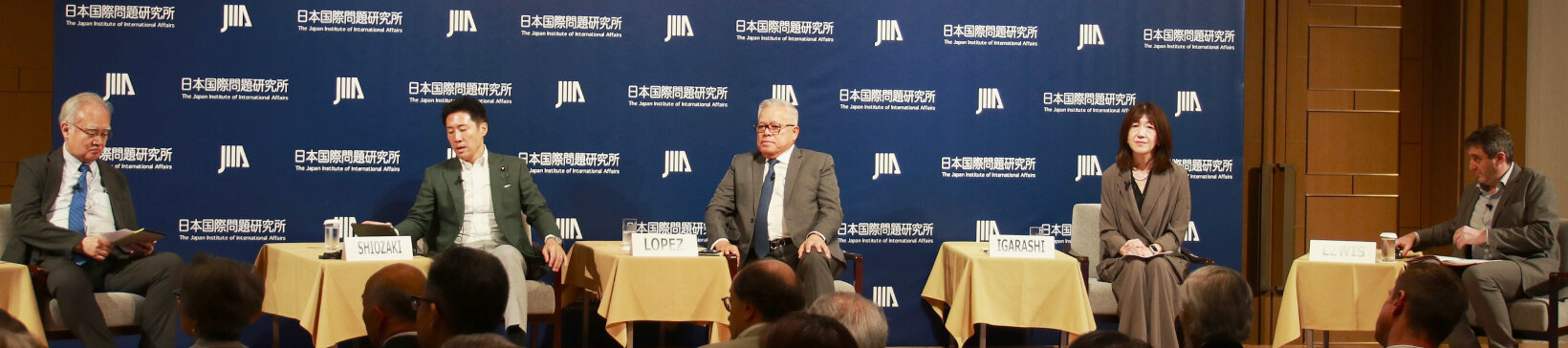
This session provided an opportunity to share the objectives and strategic rationale of the Japan Institute of International Affairs' (JIIA) National Strategy Project, while examining Japan's future approach to diplomacy and security, economic security, science and technology, the international order, and regional cooperation.
In the keynote address, it was emphasized that Japan faces a combination of worsening security conditions and domestic challenges, including demographic decline, low economic growth, and growing concerns over fiscal sustainability and social security. Against this backdrop, speakers stressed the need for a coherent national strategy integrating diplomacy, security, economic policy, science and technology, and social policy. Referring to a joint public opinion survey conducted by JIIA and The Yomiuri Shimbun, it was also noted that while the Japanese public has growing concerns about the country's future and demographic decline, there remains broad public support for a rules-based international order, free trade, and efforts to address climate change.
During the panel discussion, panelists agreed that, as the U.S.-led free and open international order undergoes significant change, Japan should continue to anchor its foreign and security policy in the Japan-U.S. Alliance while strengthening its own defense, economic, technological, and information capabilities. At the same time, Japan should deepen cooperation with like-minded partners, including Europe, ASEAN, the Philippines, Australia, and India. Panelists also discussed China's rise, uncertainty surrounding U.S.-China relations, tensions in the South China Sea and the Taiwan Strait, and challenges facing international institutions and international law.
From the Southeast Asian perspective, speakers noted that rising protectionism, expanding tariffs and trade barriers, and growing geopolitical tensions are placing increasing pressure on regional economies. They emphasized the importance of maintaining and advancing economic integration in ASEAN and East Asia, strengthening supply-chain resilience, and promoting rules-based economic cooperation through frameworks such as the RCEP and the CPTPP. Japan was recognized as a highly trusted partner with strong technological capabilities and a proven ability to contribute to regional rule-making and institution-building.
From the European perspective, panelists pointed to the weakening of the liberal international order, democratic backsliding, and uncertainty surrounding U.S. policies. They argued that Japan is uniquely positioned to explain to Europe and the broader international community the strategic implications of China's rise, drawing on its long-standing experience as China's neighbor. They also noted that Japan's consistent support for international institutions and the rules-based order positions it as an important pillar of global governance and international trust.
Throughout the discussion, panelists agreed that Japan should continue to strengthen the Japan-U.S. Alliance while enhancing its own strategic capabilities in defense, economic security, science and technology, artificial intelligence, and dual-use technologies. They also emphasized the importance of pursuing diplomacy based on trust, transparency, and fairness. In conclusion, panelists shared the view that Japan should enhance both its strategic autonomy and strategic indispensability, deepen cooperation with like-minded countries, and play a more proactive role in promoting a stable international order and regional prosperity.

TGD7 Session4 In Pursuit of Japan’s Grand Design in Turbulent Times