


Report on a Roundtable with Think Tanks in the Netherlands and Norway and Participation in the Annual Conference of a Lithuanian Think Tank

The Japan Institute of International Affairs visited the Netherlands, Norway, and Lithuania from November 17 to 21, 2025, where it conducted roundtables and participated in meetings with local research institutions. During this visit, discussions were held with the Hague Strategic Studies Centre (HSSC), the Clingendael Institute (Netherlands Institute of International Relations), and the Norwegian Institute of International Affairs (NUPI) on the transformation of the international order and security issues. In addition, Tomoyuki Yoshida, President of the Japan Institute of International Affairs, spoke at the annual meeting of the Geopolitics and Security Studies Center (GSSC).
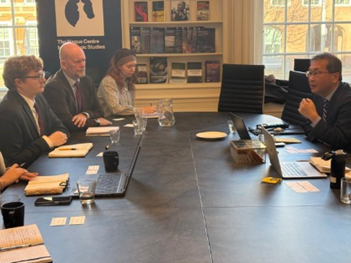
The Hague Strategic Studies Centre (HSSC)
At this roundtable, held on November 17, geopolitical and geo-economic issues were discussed, with a particular focus on great-power competition, including the role of middle powers such as Japan and the Netherlands. Key points highlighted the importance of defense cooperation—especially in the areas of semiconductors and critical raw materials—as well as the need for strategic coordination between NATO and countries in the Indo-Pacific region.
The discussion also addressed Japan’s plan to raise its defense spending to 2% of GDP and further deepen its security relationship with NATO, which was welcomed by European participants. In addition, the meeting examined challenges in the enforcement of international law—particularly in the contexts of the Gaza and Ukraine conflicts—and considered the potential economic and military implications of a contingency in Taiwan.
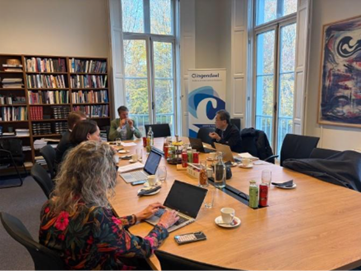
Clingendael Institute (Netherlands Institute of International Relations)
At the roundtable held on November 17, we discussed the geopolitical challenges and economic security issues facing Japan and the Netherlands. Key points included the main policy priorities outlined by the Takaichi administration and the prospects for achieving the defense spending target of 2% of GDP.
From the Japanese side, it was explained that this discussion arises from the current security environment surrounding Japan, which is becoming increasingly challenging due to accelerating global geopolitical shifts and Japan being encircled by nuclear-armed revisionist states such as China, Russia, and North Korea.
The meeting also featured exchanges on the interconnections between European and Indo-Pacific security, as well as the impact of the war in Ukraine on global stability, allowing participants to share perspectives. In addition, the discussion addressed the economic implications of security dependencies, particularly pressures associated with purchasing U.S.-made defense equipment. The session concluded by emphasizing future collaborative research efforts on these important issues.
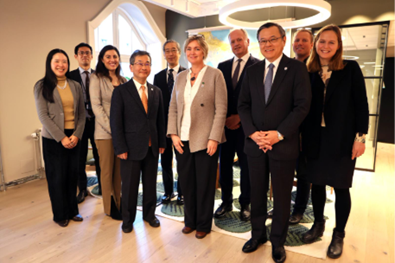
Norwegian Institute of International Affairs (NUPI)
At the roundtable held on November 19, we discussed interconnected security challenges in the Indo-Pacific and Europe, with particular attention to the impact of the war in Ukraine and the U.S.-China rivalry. Through these discussions, we confirmed a shared understanding of the need for closer cooperation among Japan, Europe, and Norway, highlighting the importance of collaboration in the military, technology, and energy sectors.
The discussion also addressed the strategic significance of the Arctic, geopolitical changes in the region, and the assessment of the unrestricted partnership between China and Russia. In addition, as a leading Norwegian think tank with a track record in facilitating the Oslo Accords, a presentation was given on developments in the Middle East, examining their impact on international governance. Norway’s perspectives on the Oslo process, the two-state solution, and relations between the U.S. and Middle Eastern countries were also shared.
The exchange of views concluded with an emphasis on promoting future collaborative research and enhancing alignment in intergovernmental policy coordination.
Geopolitics and Security Studies Center(GSSC)
The annual meeting of the GSSC, held on November 21, was attended primarily by participants from the United States and various European countries, and several co-hosted panels with major think tanks were organized. The GSSC also maintains close cooperation with the Presidential Office, which included courtesy visits to President Gitanas Nausėda, exchanges of views with the Presidential Office’s national security advisors, and a panel discussion led by the President.
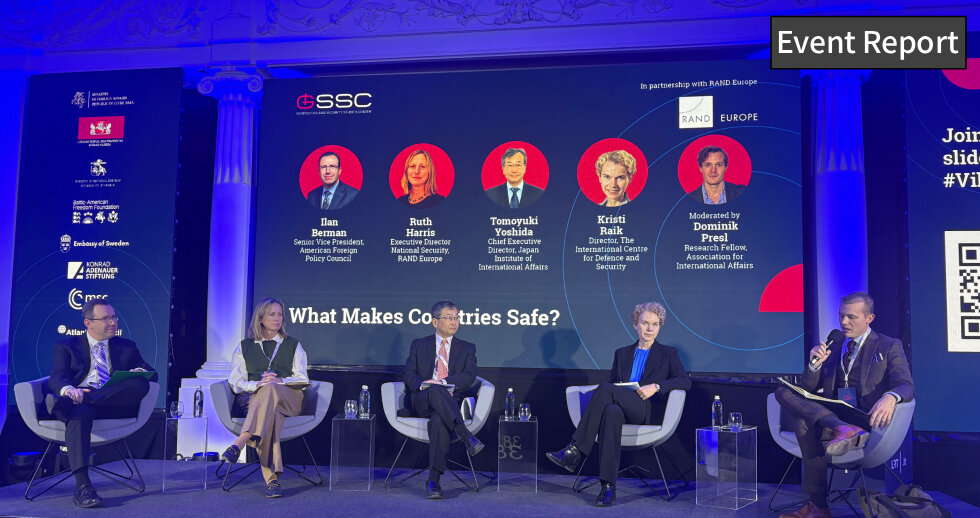
Tomoyuki Yoshida, President of the Japan Institute of International Affairs, spoke on a panel co-hosted with RAND Europe, discussing the long-term nature of national security. Other panelists included Ilan Berman (Senior Vice President, American Foreign Policy Council), Ruth Harris (Executive Director for Security and Defence, RAND Europe), and Kristi Raik (Director, International Centre for Defence and Security), with Dominic Presl, Research Fellow at the Association for International Affairs, serving as the moderator.
The discussion focused on the importance of defense will, sustained defense investment, technological superiority, and close coordination among allies, with particular emphasis on responding to the nuclear ambitions of authoritarian states such as Iran and North Korea. The panelists also addressed inefficiencies in European defense procurement and the need for a unified approach, emphasizing the importance of strategic communication, clear identification of hybrid threats, and the roles of NATO and the EU in strengthening defense cooperation.