


History and the Present of Exchange with China in Kitakyushu City: Tracing the Footsteps of the Friendship City Relationship with Dalian City
Kan Hayata (Junior assistant fellow, The Japan Institute of International Affairs)

This is a translation of the Japanese article originally published on August 29, 2024.
The original Japanese article can be found at (https://www.jiia.or.jp/jpn/report/2024/08/20240829-01.html).
When we hear the phrase “Japan-China relations,” we may think of the political relationship between the two governments. In reality, however, the Japan-China relations are multifaceted, encompassing economic relations centered on business and cultural exchanges. It would be more appropriate to understand Japan-China relations as a set of relationships consisting of various fields and actors. One such field is the exchange between local governments. This paper attempts to rethink Japan-China relations from the perspective of local governments by examining the relationship between Kitakyushu City in Fukuoka Prefecture and Dalian City in Liaoning Province as an example of Japan-China exchanges between local governments.
Kitakyushu City concluded a friendship city agreement with Dalian City in 1979, the earliest period after the normalization of Japan-China diplomatic relations, and this year marks the 45th anniversary of the friendship relationship. Although the existence of the friendship city policy is recognized by many people, the details of this policy and its impact on international relations often receive little attention. However, as we will examine in this paper, the friendship city relationship between Kitakyushu City and Dalian City has established practical cooperation in various fields, including environmental issues. The background to this is the relationship that Kitakyushu City has historically cultivated with China. This paper looks back at the history of exchanges between Kitakyushu City and China and discusses how they have been carried forward to the current friendship city relationship with Dalian City.
Keiichiro Yasukawa and Sun Yat-sen: The Beginning of Exchange with China
The origins of Kitakyushu’s exchanges with China date back to the 1910s, more than half a century before the establishment of a friendship city agreement. When discussing the relationship between Kitakyushu and China, the presence of Keiichiro Yasukawa, a leading businessman of the Meiji era, is essential.
Yasukawa, who made his fortune in coal mining in the Kitakyushu area, is known to have used his considerable financial resources to support Sun Yat-sen, who was in exile in Japan at the time. Sun Yat-sen visited Kyushu in March 1913, and on the 16th gave a lecture at the Meiji College of Technology (now Kyushu Institute of Technology), which Yasukawa had founded. That night, Sun Yat-sen stayed at Yasukawa’s residence and presented Yasukawa with a calligraphy with the inscription “World Peace.” A reproduction of the calligraphy currently hangs in the main room of the former Yasukawa residence. In November 2023, 110 years after Sun Yat-sen’s visit to the Yasukawa residence, a statue of Sun Yat-sen, created by Wu Weishan, a renowned sculptor and curator of the National Art Museum of China, was donated to the former Yasukawa residence. The statue of Sun Yat-sen in the former Yasukawa residence tells the story of how the relationship between Yasukawa and Sun Yat-sen was carried on into post-war exchange with China in Kitakyushu.
Yaskawa Electric Corporation, founded by Yasukawa in 1915, would play an important role in post-war exchanges with China in Kitakyushu, as will be discussed later.
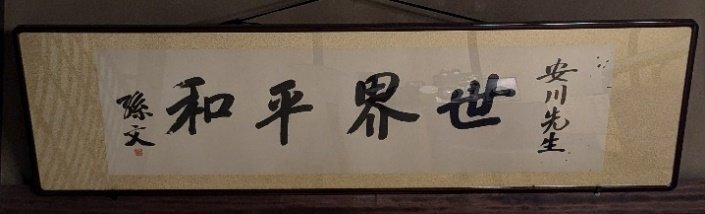
The calligraphy drawn by Sun Yat-sen, “World Peace.”
(Displayed at the former Yasukawa residence. Reproduction)
(Photographed by the author)
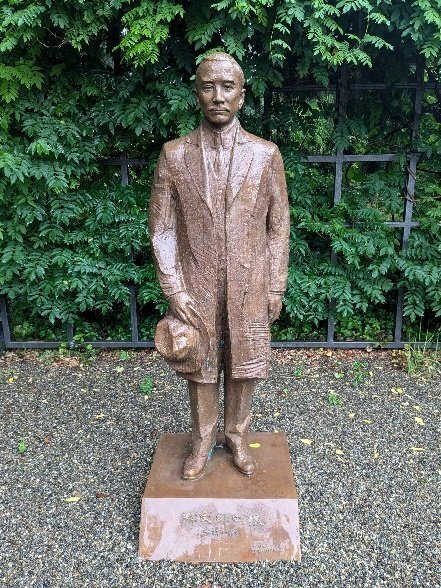
The statue of Sun Yat-sen, donated to the former Yasukawa residence from China
(Photographed by the author)
Exchanges with China Prior to the Establishment of a Friendship City Relationship
Although there were no diplomatic relations between Japan and the People’s Republic of China (PRC) from the end of the war until 1972, there were active exchanges with China in Kitakyushu even before diplomatic relations were restored, and Kitakyushu City 1frequently received visiting groups from China in the 1960s. In many cases, such groups that visited Kitakyushu City were interested in Kitakyushu’s industrial technology. Local companies such as Nippon Steel, Okano Valve, and Yaskawa Electric often hosted visits by groups from Chinese industrial associations. Huang Ju, who later served as vice premier of the State Council and secretary of the Shanghai Municipal Committee of the Communist Party of China (CPC), revealed during a visit to Kitakyushu City around 1990 that he had once been sent to Yaskawa Electric as a trainee. This is a good example of how the memory of Yaskawa Electric’s exchange with China was passed on to the central leadership of China.
After the Japan-China Joint Communique was signed in 1972, Kitakyushu City established the China Trade Office in the Economics Bureau the following month, and quickly began preparations for economic exchange with China. Throughout the 1970s, many Chinese delegations visited Kitakyushu City. In addition to the many factory visits by industry groups that continued from the 1960s, there were also exchanges in the fields of sports and culture. For example, from 1974 onwards, the Chinese table tennis delegation visited Kitakyushu on multiple occasions. Xu Yinsheng, who participated in the 1971 Sino-American Ping-Pong diplomacy and later served as President of the International Table Tennis Federation, visited Kitakyushu as a member of the delegation. Meanwhile, several delegations from Kitakyushu also visited China, and cooperation in areas such as economic exchange and port development was explored.
Kitakyushu, which was the gateway to western Japan and one of Japan’s leading industrial cities, could be said to have served as an important base for Japan’s exchanges with China.
The Establishment of the Friendship City Relationship with Dalian City
In 1979, at the invitation of Kitakyushu City, a friendship city affiliation was concluded with Lüda City in Liaoning Province (renamed Dalian City in 1981). The two cities, which are geographically close and have similar industrial structures and geographical conditions, had the potential for cooperation in various fields. As mentioned above, the foundation for exchanges with China had already been laid in Kitakyushu City, but Dalian City also had the potential for exchanges with Japan. This was because Dalian was the largest port city in Manchuria, and there were many Japanese people with ties to Dalian and the former Manchurian region. In view of this, in 1984, in a policy document designating Dalian as an Open Coastal City, the central leadership stated, “We will consider the circumstances (omission) that we must utilize Japanese capital and technology,” and spoke of the importance of Dalian as an open city (Party Literature Research Center under the Central Committee of the Communist Party of China, 2008:327). From this statement, we can see the central leadership in China also shared the recognition that Dalian was a base for exchange with Japan.
Following the conclusion of the friendship city agreement, the two cities promoted business exchanges, and there were also a wide range of other exchanges, such as visits by groups of Kitakyushu City council members and citizens to Dalian. In addition, buildings and structures were built to commemorate the anniversary of the friendship city agreement between the two cities. Here are two representative examples.
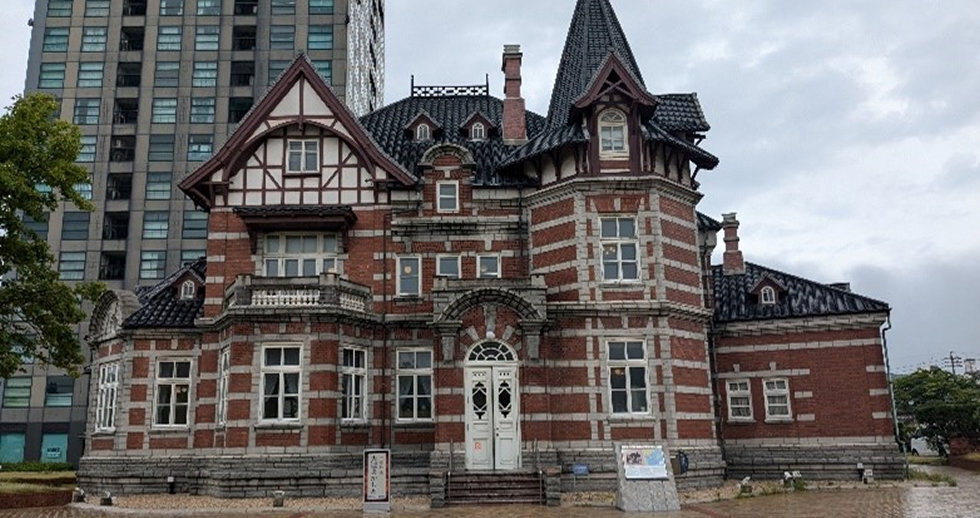
One example is the Beida Bridge, which was built in Dalian to commemorate the 5th anniversary of the establishment of the friendship city relationship. The Beida Bridge is a suspension bridge built along the coast of the Bohai Sea in the southeastern part of Dalian and was built using the technology of the Kanmon Bridge, which spans the channel between Kitakyushu City and Shimonoseki City in Yamaguchi Prefecture. Another example is the International Friendship Memorial Library (now the Dalian Friendship Memorial Hall), which was built in Moji Port in Kitakyushu City, to commemorate the 15th anniversary of the establishment of the friendship city relationship. This three-story Western-style building was modeled after the administrative office of the Trans-Manchurian Railroad in Dalian and was constructed over a period of four and a half years using 45,000 bricks produced locally in Dalian2 . These buildings are still used as symbols of the friendship between the two cities.

Painting of the Beida Bridge, exhibited in the Dalian Friendship Memorial Hall
(photographed by the author)
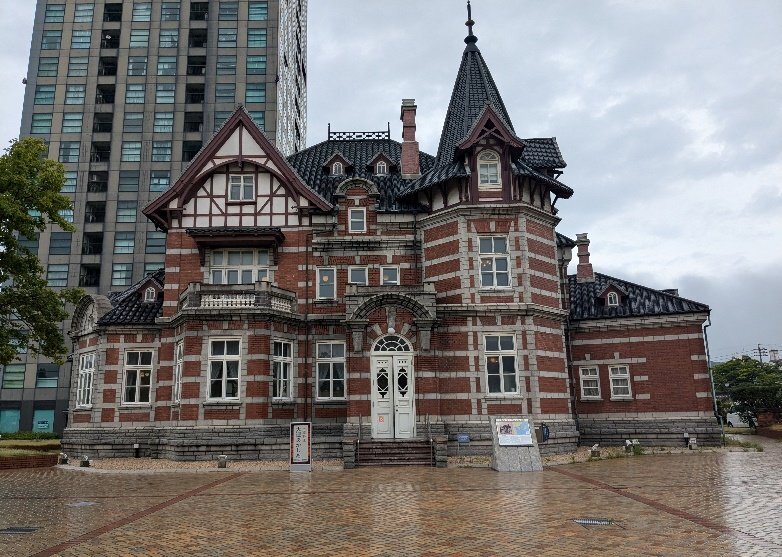
Dalian Friendship Memorial Hall
(photographed by the author)
The Dalian Environmental Model District Project
The largest exchange project between Kitakyushu City and Dalian City is the environmental project. Kitakyushu City thrived on the achievements of the heavy and chemical industries during the period of rapid economic growth in the 1960s, but as a side effect, it faced serious pollution problems. Starting with a citizens’ movement for environmental improvement, Kitakyushu City began to work on pollution control measures in cooperation with the public and private sectors, and by the 1980s had achieved great results in environmental improvement3 .
Dalian City was also suffering from environmental problems. The seriousness of the situation was recognized by the central government, and at the First National Conference on Environmental Protection held in 1973, Dalian City was designated as one of the key cities for environmental protection in the country (Dalian Municipal History and Archives Office, 2003:9). In response to this situation, Dalian City set numerical targets for environmental protection every five years from 1980 onwards and tackled environmental protection under government leadership.
The two cities, which share a common background, actively promoted cooperation in the environmental field immediately after the conclusion of the friendship city agreement. In 1981, at the invitation of the mayor, three municipal officials, including the director of the Kitakyushu City Environment Bureau, visited Dalian and held an environmental management course over a five-day period (Dalian Municipal History and Archives Office, 2003: 321-322). This kind of exchange was a great opportunity for Dalian, which had little experience in dealing with environmental issues, to gain know-how in environmental policy. The fact that more than 150 Dalian city officials attended the environmental management course in 1981 also shows the high level of interest on the part of Dalian. Since then, the environmental cooperation between the two cities was promoted in the form of support from Kitakyushu City, which already had a track record of environmental improvements.
The culmination of environmental cooperation between the two cities was the plan for the Dalian Environmental Model District Project. In December 1993, when Song Jian, the Chairman of the Science-Technology Commission of China, visited Japan, Kitakyushu Mayor Sueyoshi Koichi proposed a plan to the Chinese side to build a “Dalian Environmental Demonstration Zone.” The plan was approved by Song , so the Dalian Environmental Model Zone Project was launched jointly by Kitakyushu City and Dalian City (Dalian Municipal History and Archives Office, 2003: 315). Based on the friendship city relationship between the two cities, this project developed into a major project that involves not only the two cities, but also the central governments of the two countries. In 1994, Chinese deputy premier Zhu Rongji visited Japan and met with Mayor Sueyoshi, informing him that the Environmental Model District would be designated as a national project (Dalian Municipal History and Archives Office, 2003: 323). The Japanese side also worked together with the Ministry of Foreign Affairs, JICA, and Kitakyushu City to realize the project and it came to fruition as a Japan-China ODA project. The project involved the implementation of a wide range of environmental policies, including measures to improve air and water quality, urban greening, and exhaust gas regulations. In the process, the Kitakyushu International Techno-cooperative Association (KITA) visited companies in Dalian and provided advice on environmentally friendly industrial production methods (Dalian Municipal History and Archives Office, 2003: 323). The results of the project attracted international attention, and in 2001 Dalian became the first Chinese city to receive the Global 500 Award, given by the United Nations Environment Programme (UNEP) to international environmental leaders4 . As a result of measures such as introducing technology into factories, Dalian was able to control the worsening of air pollution even as the city industrialized and the number of cars on the road increased, and the citizens living near the factories also came to feel the improvement in the environment 5 .
As a symbol of friendship and cooperation between the cities of Kitakyushu and Dalian, and between Japan and China, the project has continued to attract the attention of China’s central leadership. In 2009, then Vice President Xi Jinping visited Japan and visited Kitakyushu City, where he received a briefing on the city’s environmental projects. The visit of the vice president was widely reported in the Chinese media, and even during the period of stagnation in Japan-China relations, the Kitakyushu City’s initiatives as an environmentally advanced city were highly regarded in China. During his visit, Xi Jinping also visited Yaskawa Electric, a symbol of Japan-China exchange in Kitakyushu City. When Yaskawa Electric President Koji Toshima explained the relationship between the company’s founder, Keiichiro Yasukawa, and Sun Yat-sen, Xi Jinping said, “The story of friendship between the founder of Yaskawa Electric and sun Yat-sen is very moving, and we must continue and develop this tradition of Japan-China friendship6 .”
Since the 2010s, Kitakyushu City has been expanding its environmental projects in cities in Southeast Asia, making use of the expertise it has gained in international environmental cooperation through its collaboration with Dalian City. In addition to establishing “Sister City Agreements” with Hai Phong in Vietnam in 2014 and Phnom Penh in Cambodia in 2016, Kitakyushu also established a “Green Sister City Partnership” with Surabaya in Indonesia in 2012 and a “Strategic Environmental Partnership Agreement” with Davao in the Philippines in 2017 and is promoting cooperation in the environmental areas such as waste management in each city. Kitakyushu City is now an international city that is making a significant contribution to the environment not only in China, but also in various parts of Asia.
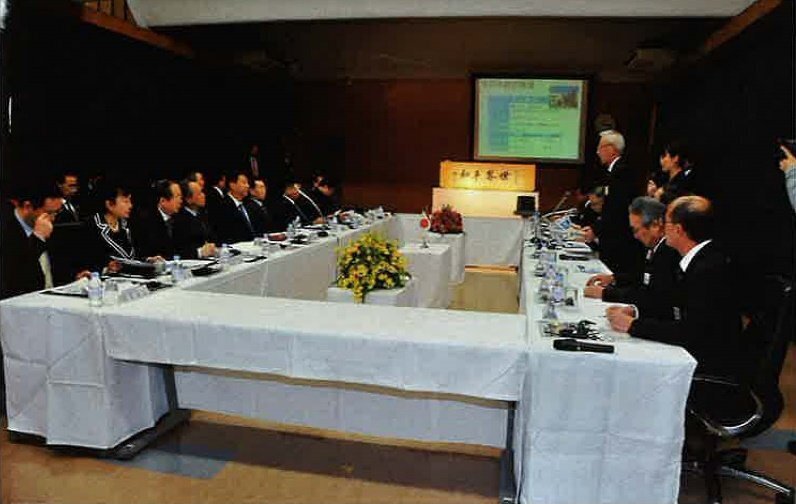
Then Vice President Xi Jinping visiting Kitakyushu City in December 2009. The calligraphy drawn by Sun Yat-sen is displayed. (Image courtesy of Mr. Yukio Nishida)
Kitakyushu City in the Context of the Japan-China Relationship
So far, we have looked at the history of exchanges between Kitakyushu City and China, centered on Dalian City, which began with the exchange between Keiichiro Yasukawa and Sun Yat-sen. As shown by statements made by Huang Ju and visits by Xi Jinping, Keiichiro Yasukawa’s exchange with China has been passed on to Yaskawa Electric Corporation, and still forms the underlying current of Kitakyushu’s exchange with China today. The foundation of Kitakyushu City’s exchange with China was realized in the form of a friendship city partnership with Dalian City, which developed into the highly acclaimed Dalian Environmental Model District Project, implemented in cooperation with the governments of Japan and China. And even this year, which marks the 45th anniversary of the friendship city partnership, exchanges between the two cities continue, with the mayor of Dalian City visiting Kitakyushu City.
Japan-China relations are always fraught with various issues, and this can sometimes lead to various obstacles in exchange between the two countries. However, exchanges between local governments are an area of Japan-China exchange that is relatively unaffected by political influences. In particular, the environmental cooperation that has developed between Kitakyushu City and Dalian City is an example of successful friendship and cooperation between local governments that share real life issues. Moreover, considering that what began as an exchange between local governments developed into a large-scale project involving the governments of both countries, it is not unreasonable to say that the exchange between the two cities has not been limited to the cities alone, but has also played a role in Japan-China relations. Kitakyushu City’s exchange with China eloquently demonstrates that local governments are also actors that make up international relations. Kitakyushu City, which has a tradition that goes back to Sun Yat-sen, is expected to continue to contribute to the maintenance and development of Japan-China relations as a hub city for exchange with China, including with Dalian City.
Acknowledgements
In writing this paper, I received a great amount of help from Mr. Yukio Nishida, former deputy mayor of Kitakyushu City, Mr. Junichi Hakamaki, Kitakyushu City special mission ambassador, Ms. Hisako Shimono, Professor of the Faculty of Foreign Studies at The University of Kitakyushu, Ms. Natsuko Takamoto, International Exchange Officer of the International Policy Division of the Kitakyushu City Policy Management Bureau, and the staff of the Kitakyushu City Archives. I would like to express my gratitude to them all.
References
(Chinese)
Dalian Municipal History and Records Office, ed. Dalian Shizhi (Dalian Municipal Records: Environmental Protection Records). Dalian University of Technology Press, 2003.
Party Literature Research Center under the Central Committee of the Communist Party of China, ed. Gaigekaifang Sanshinian Zhongyaowenxian Xuanbian (shang) (Selected Important Documents of the 30 Years of Reform and Opening Up (I)), Central Literature Publishing House, 2008.