


JIIA Strategic Comments (2026-6) Racing Ahead, Falling Apart: Middle Powers and the Future of Military AI Governance
Umi Ariga (Research Fellow, Japan Institute of International Affairs)

From AI-enabled drone surveillance in Israel to Palantir’s Maven intelligence system for NATO, military applications of artificial intelligence (AI) are rapidly moving from theoretical exploration to active deployment. Yet global efforts to govern its use remain fragmented. Some states are racing ahead to integrate AI across logistics, cyber, and command-and-control systems, while others call for robust risk assessments, human control, and multilateral accountability.
Two diverging operational logics now dominate global efforts to govern military AI. The first is a “capability acceleration” logic, centered on fielding AI systems rapidly, leveraging operational data and technological advantages before competitors. The second is a “responsible use” logic, and calls for legal compliance, lifecycle safeguards, and shared norms before adoption. Rather than engaging in a direct contest of ideas, these two governance logics are increasingly talking past each other. While declarations of shared principles might still be possible, differences in time horizons, terminology, institutional processes, and metrics of success have produced growing fragmentation in practice.
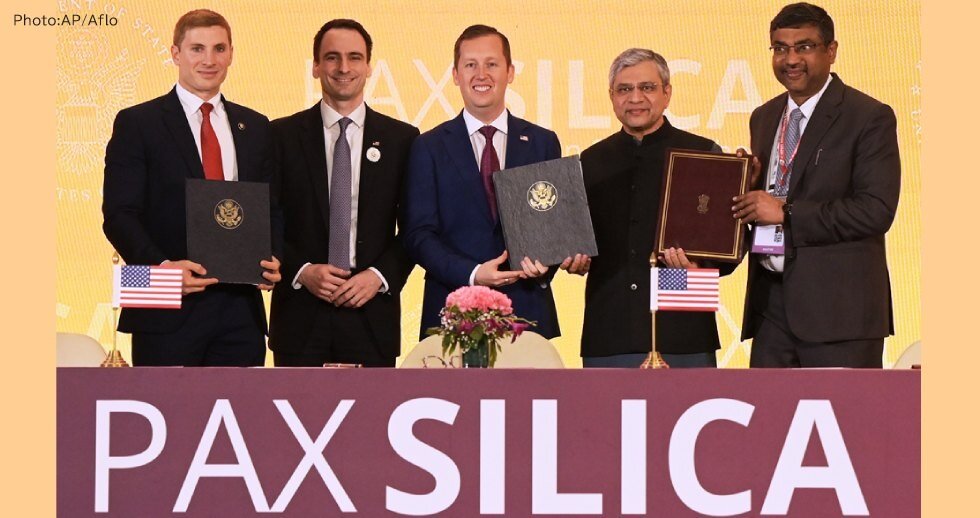
Middle powers, and especially U.S. security partners, have an opportunity to bridge this divide. Pax Silica, the U.S.-led initiative to secure AI and semiconductor supply chains, offers a practical entry point. It demonstrates that the United States cannot build military-grade AI in isolation, and that compute, chips, and data infrastructure are deeply embedded in political frameworks. Recent events make this dynamic especially vivid: in February 2026, Anthropic refused Pentagon demands to remove safeguards on its models, prompting an official ban, yet its Claude model remained deeply embedded in targeting operations in Iran. Such cases reveal the limits of unilateral control and the openings for coalition-driven norms. If leveraged wisely, Pax Silica could serve as a strategic entry point for middle powers to advance a governance anchored in shared standards.
Acceleration vs. Accountability: Why Military AI Governance Is Splintering
Recent developments reveal a growing split between two operational logics shaping military AI governance. On one side is the logic of capability acceleration, focused on rapidly deploying AI systems to secure strategic advantage. On the other is the logic of responsible use, that emphasizes legal compliance, human oversight, and multilateral coordination. While these approaches are not inherently incompatible, they are increasingly moving on separate tracks: driven by different incentives, expressed through different language, and unfolding in separate forums.
The U.S. Department of War’s 2026 AI Acceleration Strategy represents a paradigmatic expression of the capability acceleration logic. The document defines its ambition explicitly: to become an “AI-first” warfighting force and achieve “military AI dominance.” It frames speed as the decisive variable in future conflict, declaring that “speed wins,” and emphasizing the need to “weaponize learning speed.” Notably, the strategy introduces the concept of “AI model parity,” directing that frontier models be deployed in operational settings within 30 days of their public release.
This acceleration agenda is operationalized through reforms aimed at bypassing traditional safeguards in how military software is tested, approved, and deployed. The strategy advocates for a “wartime approach” to AI integration, asserting that traditional oversight, certification and risk-management practices must yield to the imperatives of speed. “We must accept,” one section reads, “that the risks of not moving fast enough outweigh the risks of imperfect alignment.” In effect, the strategy recasts deliberation, consultation, and layered review as liabilities rather than safeguards.
The result is an institutional posture in which success is measured by how quickly new tools reach the field rather than reliability or legal robustness. Without firm guardrails—on, for example, the application of international humanitarian law or mechanisms for congressional and allied oversight—this approach risks amplifying error rather than reducing it. As Quincy Institute analysts observe, rapid deployment absent deliberation may lead not to decisive breakthroughs, but to failed wars and preventable suffering. The AI arms race may very well be a race to see who loses control first.
By contrast, multilateral efforts to govern military AI remain fragmented and slow-moving. At the UN Convention on Certain Conventional Weapons, states have debated lethal autonomous weapon systems (LAWS) since 2014, but progress has stalled. The Group of Governmental Experts has yet to define what constitutes a LAWS, let alone reach consensus on restrictions or prohibitions. Meanwhile, the UN Security Council has shown little appetite to lead: despite high-level debates in 2023 and 2025, it has produced no resolutions or formal processes on AI in warfare. One emerging area of engagement is the integration of AI into nuclear command and control, which prompted the General Assembly to adopt its first resolution on AI–nuclear risks in 2025. That vote, though nonbinding, brought long-simmering concerns about inadvertent escalation and loss of human control into a formal diplomatic forum, and could gain traction in upcoming NPT discussions.
Against this backdrop, the Responsible AI in the Military Domain (REAIM) Summits have emerged as a pragmatic, multistakeholder alternative. Led by middle-power governments like the Netherlands and South Korea, REAIM is not structured around treaty negotiations but around implementation tools and voluntary coordination. Its 2026 “Pathways to Action” outcome document outlines principles such as legal compliance, sustained human involvement, and cross-regional capacity-building. Crucially, REAIM’s design incorporates technical, civil society, and industry actors, creating a bridge between normative discourse and operational realities. While not legally binding, its inclusive format allows for experimentation with safeguards and governance ideas that remain stuck in more formal UN bodies.
However, REAIM’s influence is limited by non-participation from major powers: at the 2026 summit in A Coruña, only 35 of 85 attending states signed the final declaration, a significant drop from the 60+ endorsements secured during the 2023 and 2024 meetings in The Hague and Seoul. The absence of the U.S. and China underscores the growing misalignment in political incentives and institutional pathways. This reluctance is emblematic of a broader tension between normative commitments and strategic restraint, as States are increasingly caught in a prisoner’s dilemma, wary of accepting limitations that could put them at a disadvantage vis-à-vis competitors. Additionally, for some countries, uncertainty over their relationship with the United States or China is another source of hesitancy, making states wary of endorsing principles that could later misalign with evolving great-power relationships.
As seen in conflicts in Ukraine and Gaza, AI tools are already being deployed in cyber, intelligence, surveillance and reconnaissance (ISR), and decision support roles. These uses highlight how quickly military AI is moving from theory to practice, and ahead of governance efforts. As capabilities diffuse, the strategic dilemma grows sharper: one side urges cautious, rights-based integration; the other sees delay as a liability. Without convergence, the field risks fragmenting into a patchwork of norms too slow to shape adoption and too weak to prevent harm. Meanwhile, the most pressing questions—whether systems will replicate human bias, whether machines should make lethal decisions, and how malign actors might exploit open-source tools—will ultimately be answered not by international agreement, but by whoever moves first.
| Dimension | Capability Acceleration Logic | Responsible Use Logic |
| Time Horizon | Weeks to deployment | Multi-year norm implementation |
| Key Metrics | Speed, scale, adoption rate | Compliance, risk mitigation, accountability |
| Preferred Forums | Internal execution within national defense orgs | Multilateral platforms, especially the UN |
| Core Vocabulary | “AI-first warfighting force,” “speed wins,” “weaponize learning speed,” “model parity” | “Responsible use,” “compliance with international law,”“technical safeguards” |
The Middle Power Dilemma
The absence of effective governance in the military AI domain is a systemic vulnerability for military cooperation. UNIDIR identifies several trends that demand urgent attention, particularly for states with limited capacity to manage or shape these developments. One is the growing risk of proliferation: dual-use, low-cost AI tools are increasingly accessible to non-state armed groups operating outside legal and normative frameworks. Another is escalation: efforts to integrate AI into NC3 systems raise the stakes for minor miscalculations, making even modest confidence-building measures in this area potentially stabilizing. A third is technical fragility: vulnerabilities in data supply chains, cloud infrastructure, and interoperability expose militaries to poisoning, adversarial manipulation, and automation bias. These risks are magnified in coalition settings. As recent NATO and AUKUS AI initiatives suggest, the more militaries rely on real-time data sharing and cloud-enabled integration, the more AI security becomes a collective, rather than purely national, function.
For middle powers allied to the United States, the potential cost of governance fragmentation is especially acute. Allied military AI systems must be highly interoperable to enable effective coalition operations. NATO’s AI strategy explicitly calls for “accelerat[ing] and mainstream[ing] AI adoption in capability development and delivery, enhancing interoperability within the Alliance”. U.S. analysts have similarly warned that if America and its allies “do not coordinate early and often on AI-enabled capabilities, the effectiveness of our military coalitions will suffer”. Yet interoperability, while strategically beneficial, deepens dependence. Allied forces that align their AI development with U.S. platforms inevitably tether themselves to U.S. software update cycles, assurance regimes and technical baselines, leaving middle-power militaries beholden to the United States’ evolving AI ecosystem and timelines.
This dependency is being formalized through U.S. defense-industrial strategy. A 2025 executive order launched an AI Exports Program to promote the sale of “full-stack American AI technology packages” abroad, encompassing everything from cloud infrastructure and data pipelines to the AI models and applications themselves. While this offers allies cutting-edge capabilities, it also locks them into long-term reliance on U.S. support for maintenance, software updates and proprietary subsystems. The F-35 program offers a useful analogue: allies purchased cutting-edge jets, but remain reliant on U.S.-controlled software, data, and logistics networks to keep them combat-ready. European operators have raised concerns that if relations soured, the U.S. could effectively ground allied F-35s simply by withholding software updates. In the AI context, similar dependencies could mean that allied forces end up deploying systems that have not passed through the same safeguards, legal reviews, or risk assessments they publicly support. For middle powers seeking to uphold norms while staying technologically relevant, this is an emerging dilemma—one in which alignment and autonomy may increasingly come into tension.
At the same time, Washington is increasingly using export controls to restrict adversaries’ access to advanced semiconductors and AI-enabling technologies, effectively structuring military AI development along geopolitical lines. This dual strategy of tightening exclusion outward while deepening integration inward reinforces the centrality of U.S.-led ecosystems. For middle powers, participation offers access to frontier capabilities, but it also narrows practical autonomy: performance, interoperability, and doctrinal alignment increasingly depend on remaining inside a U.S.-defined technological architecture.
Most fundamentally, fragmentation risks eroding the legitimacy of governance itself. If leading AI developers abstain from committing to responsible use while simultaneously tightening access to advanced capabilities, international norms lose their relevance. As a result, we are witnessing two parallel conversations with limited overlap: one focused on responsible use, the other on capability acceleration and strategic exclusion.
Pax Silica as a Governance Platform
Despite the risks that interdependence poses, it also offers leverage to middle powers. Initiatives like Pax Silica, focused on securing AI and semiconductor supply chains, offer a strategic foothold precisely because they institutionalize interdependence. The United States cannot achieve military AI self-sufficiency alone: it relied on allies for critical minerals, fabrication capacity, hyperscale cloud infrastructure, and cross-border data ecosystems. Pax Silica’s “coalition of capabilities” architecture implicitly acknowledges that compute and infrastructure are alliance-level assets. This embedded interdependence gives middle powers influence over the terms of cooperation. By conditioning access, setting shared standards, or requiring upstream assurance measures, they can help shape the operational guardrails of frontier systems.
One of the key structural problems in military AI is that governance interventions often occur downstream, after key design, procurement, or deployment choices are already locked in. This creates resilience gaps between where risks emerge and where governance mechanisms operate. Middle powers like South Korea and the Netherlands—key players in both Pax Silica and REAIM—are especially well-positioned to embed governance upstream, at critical junctures in the AI and semiconductor supply chain. Whether through South Korea’s and Japan’s processing and chip-design capabilities or the Netherlands’ dominance in advanced equipment, these actors have influence over the technical and assurance layers where safeguards can be embedded before systems are fielded.
One promising avenue is to develop shared AI assurance baselines tied to procurement eligibility across the Pax Silica ecosystem. These could include common requirements for auditability, testing and evaluation, red-teaming standards, lifecycle documentation, and incident-reporting mechanisms. Conditioning access to shared compute, supply chains, or joint projects on compliance with such standards would translate responsible-use principles into operational criteria.
Second, middle powers should prioritize robust data governance. In coalition environments, AI performance depends on the quality, traceability, and interoperability of data. Pax Silica members, many of whom are also U.S. military allies, could align standards for data curation, provenance tracking, security, and update protocols. This is not just a technical concern but a collective risk: alliance AI systems are only as secure as their weakest link. A single partner’s poorly governed dataset can corrupt shared models, producing dangerously flawed outputs. By treating data as a shared strategic asset rather than a national afterthought, middle powers can strengthen both operational capability and mutual trust.
Third, Pax Silica could serve as a platform for sustained technical dialogue and capacity-building. Joint training standards for human–machine teaming, shared red-teaming exercises, and coordinated incident-learning mechanisms would promote human capital and oversight. These efforts would complement UN-level debates by focusing on implementation: how systems are tested, how operators are trained, and how feedback loops inform design revisions.
Finally, middle powers can use their position within Pax Silica to engage private-sector actors directly. Most military-relevant AI is developed by industry, and recent events underscore the leverage this affords. Anthropic’s refusal to permit the use of its models for autonomous targeting and mass surveillance resulted in a federal ban and “supply chain risk” designation, but this did not prevent its Claude model from being used during U.S. strikes on Iran. This illustrates the Pentagon's deep operational dependence on private AI systems and the difficulty of fully disentangling them. Middle powers can seize this window to reinforce emerging private-sector norms by backing initiatives that embed meaningful guardrails into defense-relevant AI. One practical pathway is convening peer-to-peer (P2P) dialogues among firms to encourage voluntary alignment on terminology, risk taxonomies, and operational safeguards. Establishing shared lexicons and assurance standards would create soft convergence on key principles, even amid strained government-to-government dynamics.
Taken together, these measures would form a pragmatic governance agenda rooted in interdependence. Rather than seeking sweeping declarations or legal prohibitions that are unlikely to gain consensus, middle powers can use their leverage within trusted technology ecosystems to shape assurance standards, data practices, and lifecycle safeguards. Pax Silica offers U.S. allies a credible venue to exercise precisely that influence.