


Chapter 3: US-China Coexistence and the Taiwan Situation in a Period of Fragile Stability
Yumi Iijima (Research Fellow, The Japan Institute of International Affairs)
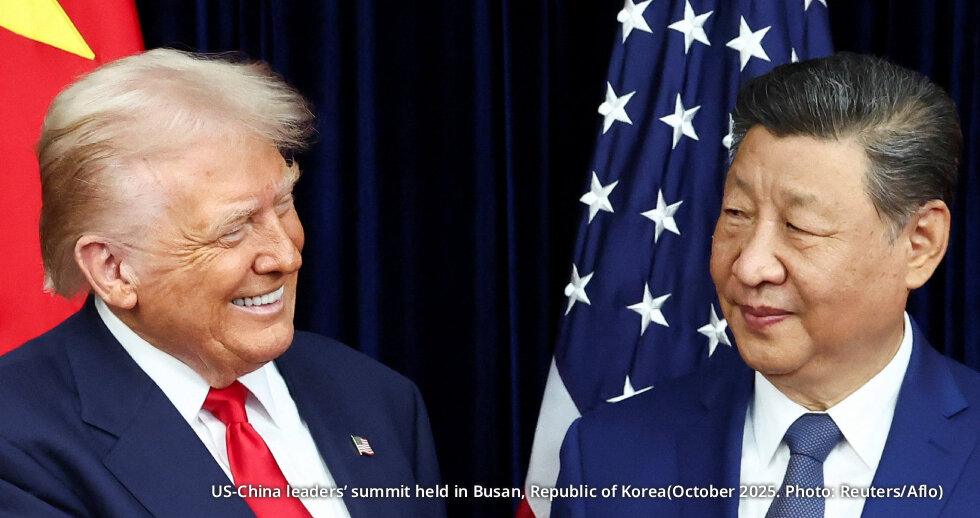

Managing frictions in US-China relations through leader-level diplomacy
US-China relations in 2025 largely revolved around tariff negotiations initiated by the Trump administration. Washington sought to use tariffs as a tool to extract concessions from China, but it was ultimately thrown off balance by China’s countermeasures – e.g., leverage over rare earths – deployed after carefully studying US tactics and vulnerabilities. At the US-China summit held on the margins of the APEC Leaders’ Meeting in the Republic of Korea, the two sides agreed to temporarily suspend certain tariffs and export-control measures, halt the collection of additional port-entry fees, and increase imports of US agricultural products. These steps produced a temporary easing of bilateral frictions. Although the risk remains that tensions could again cycle between escalation and de-escalation depending on the implementation of these commitments, China at present appears willing to comply. Media reports indicate that China has already purchased about two-thirds of the agreed volume of US soybeans.
In 2026, multiple leader-level interactions are anticipated: reciprocal visits by the two presidents, as well as summit meetings on the margins of the G20 (hosted by the United States) and APEC (hosted by China). These channels of summit diplomacy are expected to help sustain a relatively stable relationship. With an eye on the midterm elections, the Trump administration is likely to remain flexible in striking deals with China that deliver tangible gains for the US economy and businesses. For its part, China has gained confidence that it can push back against US economic coercion and conduct trade negotiations on a more equal footing. While Beijing seeks stabilization and cooperation with the United States where feasible, it has not changed its view that the relationship is fundamentally one of strategic competition. China will likely continue steadily implementing national plans to foster and expand emerging and future industries.
There was no mention of Taiwan during the summit in Korea. However, after tensions in Japan–China relations rose over Prime Minister Sanae Takaichi’s comments on a Taiwan contingency, a phone call in November 2025 reportedly saw President Xi Jinping devote substantial time to the Taiwan issue. The Chinese side publicly stated that President Donald Trump had understood the importance of the Taiwan issue to China. While this may reflect an intent to warn Japan, it also appears to be an attempt – reminiscent of the “new type of major-country relations” once proposed to the Obama administration – to portray a relationship in which major powers respect each other’s “core interests”. President Trump likewise described the US-China relationship as a “G2”. The National Security Strategy (NSS) released by the Trump administration at the end of the year emphasizes the Western Hemisphere. The language on China has shifted markedly from previous formulations: deterrence of conflict over the Taiwan Strait is identified as a priority, but the tone of vigilance toward China is softened. For China, 2026 presents an opportunity to shape a new major-power relationship with the United States, and Beijing may also hope through leader-to-leader ties to constrain hardline forces within the United States.
At present, there is no clear objective evidence that the Xi Jinping regime is entering a lame-duck phase, and Xi is expected to secure another term at the Party Congress in 2027. At the same time, close attention will be paid to how generational turnover proceeds and whether personnel signals begin to clarify the trajectory of the post-Xi era.
Taiwan’s domestic politics ahead of islandwide local elections
Following the failure of recall votes targeting Kuomintang (KMT) legislators, the Lai Ching-te administration continues to face difficult governance as a minority government. The KMT has elected Cheng Li-wen, widely viewed in practice as “pro-China”, as its new party chair.
In November 2026, Taiwan will hold islandwide local elections, a contest of great domestic political significance. Both major parties aim to nominate candidates early to gain an advantage. Social media campaign strategy is expected to be crucial, and the youth vote will be decisive. A majority of Taiwanese public opinion favors maintaining the status quo in cross-strait relations; Chair Cheng’s pro-China line may backfire if it is fully reflected in the KMT’s campaign strategy. Meanwhile, the Democratic Progressive Party’s (DPP) slogan of “resist China, protect Taiwan” is also losing resonance.
Political turbulence in Taiwan and the KMT chair’s tilt toward Beijing create a major opening for China to shape conditions favorable to the KMT, and Beijing is likely to engage in full-scale influence operations.
Recommendations
- China viewed Prime Minister Takaichi’s political beliefs and stance on Taiwan as problematic, and thus intensified pressure on Japan following her Diet testimony in November on “situations threatening Japan’s survival” (sonritsu kiki jitai ). The purpose of harsh measures against Japan is to engineer changes to the status quo favorable to China and to generate social anxiety and polarization within Japan. As Japan proceeds with revisions to its three strategic documents and strengthens intelligence functions, China is likely to accelerate its pressure out of wariness of these developments. Beyond responding to military and economic coercion, Japan urgently needs to build a society resilient to disinformation and cognitive warfare. China will continue to amplify globally the anti-Japan narrative that Japan is reviving militarism and challenging the postwar international order. Japan must calmly step up objective counter-messaging and proactively deliver careful explanations internationally.
- While US-China relations carry the risk of renewed tension, 2026 is expected to see up to four in-person US-China summit meetings, and the relationship is likely to remain comparatively stable. China’s hardline posture toward Japan will continue in 2026, and its pressure against Taiwan will further intensify. Japan should reinforce the Japan-US alliance and enhance necessary deterrence and response capabilities, while also maintaining persistent dialogue with China.
- China will serve as the host economy for APEC 2026 and convene the Economic Leaders’ Meeting in Shenzhen. This will offer Beijing an opportunity to expand the narrative that it is a defender of free trade and a responsible, exemplary major power. The modality of Taiwan’s participation will also draw attention. Japan should demand consistency between China’s words and actions as a “model major power” working in coordination with other partners. Japan should also urge China as host to ensure the effective participation of all APEC economies and to contribute to progress in international cooperation.
(December 31, 2025)