


- #Korean Peninsula
- #Russia, Central Asia & the Caucasus
- #China
- #Security
- #JIIA Strategic Comments
- #Strategic Outlook 2026
Chapter 4: The Korean Peninsula: The ROK and North Korea Seek to Expand Their “Survival Space” Amid Unrest in the International Order
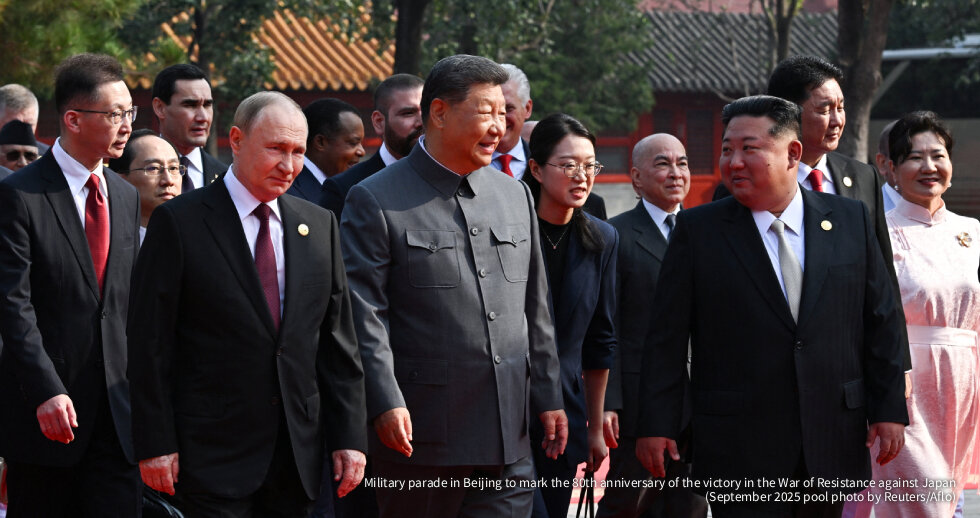

North Korea seeks closer relations with Russia and China
North Korea publicly announced its involvement in the Ukraine war in April 2025 and the dispatch of an engineering unit in June of the same year, emphasizing the "alliance" between Russia and North Korea. In return, North Korea is said to have received foreign currency revenues, advanced military technology, and loopholes in economic sanctions. It is also seeking to utilize drones and other modern warfare know-how to strengthen its military.
At the September Russia-North Korea summit held in Beijing, President Vladimir Putin described the relations between the two countries as "special ones of trust, friendship and alliance," demonstrating a deepening relationship. North Korea was also striving to further develop its relations with China, which responded favorably as it sought to expand its influence on the Korean Peninsula. Kim Jong-un's visit to China in September (see above) led to the first China-North Korea summit in six years, in which the two countries pledged to strengthen their ties with no mention of denuclearization.
Kim Jong-un standing alongside President Xi Jinping and President Putin at the military parade held in September to mark the 80th anniversary of China's victory over Japan highlighted the transformation of ties among China, Russia, and North Korea from intersecting lines to a plane.
Formation of an "axis of upheaval"?
It would be more appropriate to view these developments as the result of the convergence of each country's interests with an eye toward its relationship with the United States rather than as the formation of a China-Russia-North Korea "camp". Furthermore, North Korea is pursuing a comprehensive military buildup with support from Russia. When comparing the economic benefits North Korea is reaping from sending troops to Russia with the benefits the ROK gained from its participation in the past Vietnam War, though, the former lacks the crucial element of securing a broad export market. Continuing its military buildup under these circumstances will distance North Korea from the "visible economic growth" that is key to regime stability. There is no sign of a reduced security risk and increased peace dividend emerging under the Russia-North Korea "alliance."
If cooperation among China, Russia, and North Korea deepens further in the future, we can expect such developments as North Korea participating in joint Sino-Russian military exercises, North Korea conducting new nuclear tests, and Russia and China blocking the adoption of Security Council resolutions. More so than these, however, the progress made in each country's negotiations/relations with the United States and the degree to which cooperation becomes visible in that process will be a measure of the true state of China-Russia-North Korea relations. North Korea, mindful of the possibility that China and Russia might "abandon" it through improved relations with the United States, will likely signal its interest in dialogue even as it puts on displays of its military achievements in order to take part in arms control negotiations as a nuclear power and normalize relations with the United States in ways that would include the withdrawal of US troops from the ROK, all the while attempting to "entangle" China and Russia in the process.
Circumstances in the ROK and Japan-ROK relations
Following the December 2024 state of emergency and the April 2025 presidential impeachment, the ROK held a new presidential election in June that was won by Lee Jae-myung of the progressive Democratic Party of Korea. President Lee was elected with the backing of a large ruling party and a strong internal base, but the vote share of progressive and conservative candidates in the presidential election was closely matched, highlighting domestic political divisions. Considering these circumstances, the Lee administration has been cautious in its governance since its inception, particularly in the field of diplomacy, where it has sought to maintain foreign relations based on "pragmatic diplomacy centered on national interests". Furthermore, it has emphasized stable management of Japan-ROK relations by arranging a Japan-ROK summit meeting shortly after taking office, conducting joint US-ROK and Japan-US-ROK military exercises, and continuing the communication between foreign and security authorities that was restored during the Yoon Suk-yeol administration. On the Japanese side, the new Sanae Takaichi administration that took office in October 2025 has expressed its intention to place importance on Japan-ROK relations and, with the international situation becoming more fluid, relations between the two countries have remained good.
However, the Lee administration's foreign policy is being pursued along two lines: pursuing the US-ROK alliance and easing tensions with North Korea. There is the risk that these two approaches may diverge over the medium to long term. The former is likely to escalate into discussions over increases in host nation support and defense spending, as well as the return of wartime operational control (OPCON), the involvement of United States Forces Korea (USFK) in regional security, and an expansion of the ROK military's role outside the Korean Peninsula, leading directly to "entanglement," something particularly abhorrent to the ROK's progressive governments particularly abhor. The latter approach would inevitably be unilateral, given North Korea's "two hostile states" approach. Were North Korea to reverse its current hardline stance and adopt a "dialogue mode," it would likely seek to alienate the ROK in aspiring to direct negotiations with the United States. In that case, extremely conciliatory policies toward North Korea and calls for the elimination of sanctions could emerge within the ROK, potentially disrupting relations with the United States and Japan.
Recommendations
- The rapprochement among China, Russia, and North Korea is the result of a shared desire to exploit the instability of the international order. Further disruption in the international order could encourage countries to divide into camps, so Japan must accurately grasp the internal contexts of these countries and work to support the international order.
- The US's tendency to focus on the Western Hemisphere and preference for bilateral deals are also concerning from the perspective of maintaining order on the Korean Peninsula. The US must be made aware that institutionalizing Japan-US-ROK cooperation, streamlining security cooperation, strengthening sanctions monitoring, and creating a comprehensive roadmap linking North Korea's "dialogue mode" to denuclearization (including the resolution of the abduction issue) would also benefit US national interests. It is important for Japan and the ROK to work together in such efforts.
- Following the inauguration of the ROK's Lee administration, concerns have been raised in Japan about the ROK's increasingly hardline Japan policy. Meanwhile, the change in government in Japan (the launch of the Takaichi administration) has raised concerns in the ROK about Japan's "rightward shift", suggesting a growing possibility of a connection between domestic and foreign policy in both Japan and the ROK. It must be understood that Japan-ROK relations have once again entered a "management" phase, where mutual restraint and the separation of domestic and foreign policy are essential.
- The two countries need to avoid heightened tensions arising from the intertwining of individual historical and territorial issues; to expand cooperation in facing up to common social challenges such as global issues, declining birthrates and aging populations, and regional development; and to reaffirm and redefine issues that can become either centripetal or centrifugal forces, such as security (the Japan-ROK ACSA), economic partnership (the ROK's accession to the CPTPP), and policy toward North Korea.
(December 31, 2025)