


- #Russia, Central Asia & the Caucasus
- #Americas
- #Europe
- #Korean Peninsula
- #Security
- #JIIA Strategic Comments
- #Strategic Outlook 2026
Chapter 6: Will Russia’s Invasion of Ukraine Ever End? The Path of Ceasefire Negotiations and the Deepening Russia-North Korea Relationship

The path of ceasefire negotiations
Mediation efforts toward a ceasefire accelerated significantly with the start of the second Trump administration in the United States, as frequently promised by Donald Trump during his election campaign.
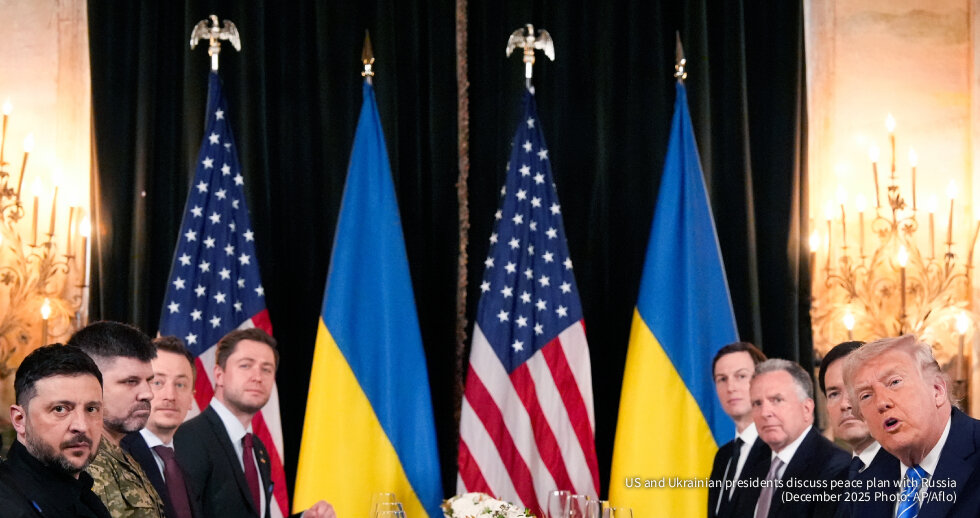
Following summit meetings with both Russia and Ukraine and mediation efforts, the Trump administration presented a new ceasefire proposal in November initially spanning 28 points. This proposal was streamlined to 20 points due to opposition from Ukraine and Europe as well as the presentation of counterproposals. Concrete negotiations are currently underway based on this revised content.
While the ceasefire proposal includes elements unacceptable to Ukraine, such as territorial concessions and weak security guarantees, Ukraine is negotiating with the US toward an agreement, driven by fears that President Trump, eager to secure a ceasefire agreement within the year for the sake of his legacy, might withdraw US support if displeased, as well as by distrust from the West stemming from Ukraine's severe domestic corruption issues. Consequently, Ukraine has effectively abandoned its NATO membership aspirations, conditional on post-ceasefire security guarantees. However, negotiations stalled during the December summit over issues pertaining to the status of Russian-occupied territories, preventing an agreement.
Russia's ceasefire conditions remain consistent: the annexation of occupied territories in eastern Ukraine and the removal of the "root causes" - namely, Ukraine abandoning its ambitions for NATO membership and its pro-Western policies, reducing its military capabilities to decrease perceived threats, and adopting a more pro-Russian stance. In negotiations with the US, Russia appears to insist that the territories remain under Russian control and that Ukraine abandon its NATO aspirations as absolute conditions. Therefore, unless an agreement acceptable to Russia is reached on these terms, it is unlikely to back down from continuing the war. Indeed, during his annual press conference in December, President Vladimir Putin rejected any concessions on ceasefire terms. He instructed the military to secure full control of the southern Zaporizhzhia Oblast, where offensives continue. Amid the stalled US-Ukraine negotiations, he maintains a hardline stance toward Ukraine and the West, seeking to further solidify Russia's current advantages.
Many observers view the military situation as tilted in Russia's favor, and concerns are mounting over support fatigue in Europe. Ukraine will likely be forced to choose which conditions it deems non-negotiable and what it is willing to sacrifice in return. Ceasefire negotiations are highly likely to continue into 2026. Even if a ceasefire is agreed upon involving a transfer of the occupied eastern regions of Ukraine to Russia, concerns remain that Russia, citing the need to address the "root causes," may violate the agreement and continue its invasion. Therefore, the sustainability of support from Europe and the West, along with a commitment to the effectiveness and sustainability of a ceasefire agreement - including security guarantees should one be reached become even more critical.
What sustains Russia's war effort?
While monitoring moves toward a ceasefire, Russia remains steadfast in continuing the war. Nevertheless, its domestic economy is rapidly deteriorating and real GDP is slowing. Although the domestic economy is considered healthy due to expanding military demand, civilian demand remains weak, and both exports and imports are declining. Domestic and foreign demand suggest the economy on the whole is "on the brink of recession" (as stated by Minister of Economic Development Maxim Reshetnikov in June). Sanctions imposed by the United States on major oil companies in October are expected to reduce Russia's national income over the medium to long term. That said, no significant domestic disruption has occurred. Russia is compensating by "importing" human resources, such as military manpower and labor, from North Korea to sustain its war-fighting capabilities. Moreover, economic support from China and the circumvention of sanctions via Global South countries mean this configuration is unlikely to undergo major changes.
Deepening Russia-North Korea relations and progress toward an "alliance"
The previously unofficial mobilization of North Korean military personnel became effectively evident around April. With the participation of Security Council Secretary Sergei Shoigu in related ceremonies held in Pyongyang, Russia-North Korea relations are expanding beyond mere military coordination.
North Korea is not only providing weapons and ammunition and deploying troops but it is also sending personnel into Russia as a source of alternative labor. Russia, in turn, is not only effectively supporting North Korea through military technology transfers and enabling it to gain combat experience but it is also establishing a long-term, multifaceted framework by such means as reopening air and rail routes between Moscow and Pyongyang, initiating construction of a road bridge, and signing agreements on cooperation in higher education. As the invasion drags on, North Korea is evolving beyond a mere tool for Russia to prolong the war into an "alliance" viewed from a medium-to-long-term perspective. This progression in their relationship is likely to continue even if a ceasefire is agreed upon.
Recommendations
- Despite economic sanctions and international criticism, the invasion persists. Should a ceasefire be achieved in the future, potentially forcing Ukraine to compromise on territorial or security guarantees, the impact on the existing international order would be significant. This could also lower the threshold for decision-making regarding unilateral changes to the status quo involving force. While Japan is not in a position to participate in ceasefire negotiations, vigilance is required regarding the manner in which the war concludes. First, the Japanese government must remain unwavering in its continued support for Ukraine. Should a ceasefire be achieved, Japan should take an active part in Ukraine's post-war reconstruction and extend cooperation into areas such as demining and minesweeping. Furthermore, Japan must consistently maintain its opposition to attempts to unilaterally alter the status quo by force. Going forward, Japan should relax the operational guidelines of the Three Principles on Transfer of Defense Equipment and Technology to enable necessary and appropriate support for nations like Ukraine facing illegal invasions.
- While improvement in Japan-Russia relations is unlikely as long as its invasion of Ukraine continues, Russia remains Japan's neighbor. Japan-Russia relations are intertwined with the strategic relationships among the three major powers the United States, Russia, and China and are crucial for Japan's security. Therefore, discussions on rebuilding Japan-Russia relations after a ceasefire are indispensable. To this end, Japan should maintain and develop appropriate dialogue channels with Russia through Track 2.0 meetings and other approaches.
(December 31, 2025)