


Discovery of 1934 Film Footage of Takeshima and the Japanese Sea Lions
Takao Inoué(Professor Emeritus at Tottori University)
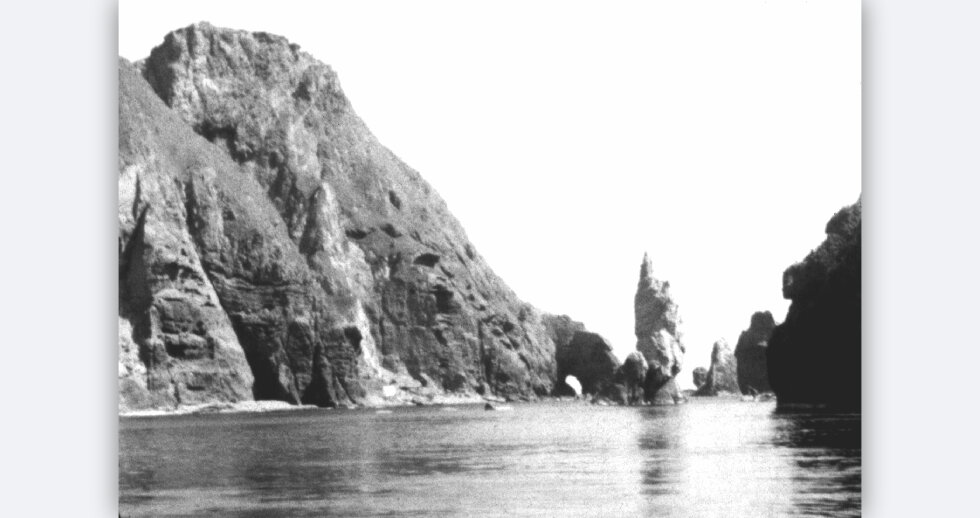

Takeshima is a remote island in the Sea of Japan. Records indicate that, since the Edo period, people traveled there to collect marine products and hunt sea lions. It is not an island that can be easily reached. Japanese sea lions once inhabited the area, and the unique nature of hunting them drew several newspaper reporters to the island. Although the Japanese sea lion was once widely distributed across the Japanese archipelago and parts of the Korean Peninsula, it disappeared shortly after the end of World War II.
Overview of the 1934 Coverage and the Nakawatase Album
In June 1934, the Osaka Asahi Shimbun conducted a large-scale journalistic coverage of Takeshima. Accompanied by a veterinarian from the Osaka Municipal Zoo (now Tennoji Zoo) and an animal dealer, the crew traveled to Takeshima and produced an 11-part serialized series on the island and sea lion hunting there. They also created a taxidermy specimen of a sea lion known as the “King of Liancourt” and organized a “Liancourt Islands Summer Exhibition.”
The expedition members were reporter Naoji Matsuura, photographer Giichi Hasegawa, veterinarian Shinzo Terauchi of the Osaka Municipal Zoo, and animal dealer Chuichi Nakata from Kobe. During their coverage, they were assisted by Kôichi Ikeda, who held the rights to sea lion hunting, and by chief hunter Nisuke Nakawatase, who had long been engaged in sea lion hunting and was thoroughly familiar with Takeshima.
In October 1992, the author and Mr. Hitoshi Sato—then head of the Education Division at the Shimane Nature Museum of Mt. Sanbe “Sahimel”—received a photo album documenting the expedition, known as the Nakawatase Album, from Mrs. Natsu Nakawatase, a relative of chief Nakawatase. Both the author and Mr. Sato had previously conducted interviews on Japanese sea lions in the Oki Islands.
Written on the inside cover is the inscription: “Presented to Mr. Nakawatase—commemorating the sea lion hunt on Liancourt Island in the Sea of Japan—June 1934, Osaka Asahi Shimbun, photographed by Giichi Hasegawa.” Liancourt Island is another name for Takeshima, and fishermen working around the island referred to it as “Ranko” or “Lyanko.”
Based on the Nakawatase Album and the serialized newspaper articles, I was able to publish Nihonkai/Takeshima no Ashika Ryo [Sea Lion Hunting around Takeshima, Sea of Japan], (Sankei Shimbun Publication Inc., 2025) in March 2025, with the cooperation of the Japan Institute of International Affairs (JIIA). The book presents an account of Takeshima and sea lion hunting as they were at the time. Through the digital processing and restoration of the album’s photographs, along with an analysis of the newspaper articles, I clarified details of Takeshima’s natural environment and the sea lion hunting practices of the period.
Discovery of the Film Footage
Having a strong desire to view the film, I pursued leads, asking contacts to search the Osaka headquarters of the Asahi Shimbun and even to reach out to Hasegawa’s surviving family members. Whenever I received information suggesting that the film might still exist somewhere in Tokyo, I conducted extensive searches; however, in the end, the film footage could not be located.
On April 18, 2025, the National Museum of Territory and Sovereignty (Kasumigaseki, Chiyoda-ku, Tokyo) reopened after renovation. I had the opportunity to be involved in the production of video content for the Takeshima section of its newly established immersive theater.
During the renovation project, the Office of Policy Planning and Coordination on Territory and Sovereignty, Cabinet Secretariat, investigated audiovisual and photographic materials and discovered that the film in question was preserved at the National Film Archive of Japan (hereafter “Film Archive”). I was then asked to conduct research and analysis of the film.
The materials discovered consisted of three 100-foot reels of 16 mm film. At the Film Archive, they had been digitized and combined into a single reel (approximately 89 meters in length.) When I first viewed them, the chronological order appeared inconsistent, leading me to suspect that the footage might have been assembled from leftover film spliced together rather than a complete, originally intended work.
Moreover, the resolution was low, making detailed analysis—particularly of individuals—difficult. Although I wished to conduct a thorough examination of the footage over an extended period, constraints imposed by the Film Archive’s regulations posed challenges for in-depth analysis and public release.
Following consultations between the Film Archive, JIIA, and other parties, the film was temporarily loaned to JIIA, which commissioned a contractor to carry out digital remastering for public release including high-resolution rescanning using the latest digital technologies.
The restored footage was significantly clearer, with image quality improved to the point that even mold on the film was distinctly visible. This enabled a detailed, extended analysis of the material.
According to information provided by staff at the Film Archive, it became clear that a censorship system was in place for film screenings at the time. In Volume 18 of Eiga Ken’etsu Jihō [Film Censorship Bulletin], compiled by the Police Bureau of the Home Ministry, a record was found indicating that a film titled Sea Lion Hunting in the Sea of Japan, produced by the Osaka Asahi Shimbun, had been subjected to censorship. The film was 35 mm format, consisting of a single reel with a total length of 269 meters.
The film discovered on this occasion, however, is 16 mm, whereas the version screened at the time was 35 mm, making it clear that the surviving film is not the one originally exhibited.
Takeshima in 1934: Captured on Film
The digital remastered 16 mm films were aligned chronologically and inspected. In total, there were 64 cuts, and the film’s duration was 10 minutes and 48 seconds. Only one segment showed evidence of having been spliced, and the cuts in the reel appear to preserve their original shooting order.
From the weather conditions and wave patterns visible in the footage, we estimated the climate and wind velocity at the time of filming. In conjunction with weather charts and previously documented records of the coverage team’s movements, this enabled a detailed analysis and reconstruction of the shooting sequence across the three reels.
The footage begins with images of the mountains of Dogo, one of the Oki Islands, filmed from a vessel on the Oki route. It shows the island as it appeared upon arrival on the morning of June 5, 1934, following departure from Sakaiminato on the night of June 4 aboard an Oki Kisen ferry.
Following a scene of the ship entering Saigo Port, the film depicts the umaire (horse-entry) ritual of the Goreé furyuu festival at Tamawakasu no Mikoto Shrine—one of the three major festivals of the Oki Islands—held on the same day. The film crew was delayed in Saigo while waiting for favorable sea conditions. During this time, they appear to have visited Senjōjiki, near Saigo, where they observed the Dossari-bushi dance, which is also captured in the footage. Together with the footage of the umaire ritual, this is believed to constitute the oldest surviving visual record of these events and is therefore of considerable historical value.
At 4:00 p.m. on June 9, the party departed Saigo aboard the motorized vessel Daiichi Shinpuku-maru (12 tons). The footage shows this departure, along with scenes of people gazing intently at Takeshima as it comes into view the following morning.
Takeshima consists of Higashijima (East Island), Nishijima (West Island), and numerous surrounding rocks; however, the base for hunting activities was located at a gravel beach on Higashijima known as Ishihara (Fig. 1). After landing there and setting up tents, the party observed sea lion hunting firsthand.
The footage shows them departing from Ishihara in a hand-rowed wooden boat known as kanko and heading toward the northern coast of Nishijima, one of the hunting grounds. Nets are spread and hunting is conducted to the north of Nishijima, after which the captured sea lions are towed, still in their nets, back to Ishihara. The footage shows the retrieval of the nets and the process of placing the animals into cages (Fig. 2), as well as the transportation of the cages containing the sea lions to the seashore by hand.
These scenes vividly portray the various stages of sea lion hunting. The hunters engaged in the hunt, the onlookers observing them, and the sea lions confronting the hunters all convey an intensity that is unique to moving images.
There is also footage of sea lion behavior. It shows herds of sea lions: group resting on rocky reefs; individuals that, having been relaxing, are suddenly startled by the film crew and plunge into the water one after another; and young pups that have only just learned to swim, struggling to haul themselves onto the rocks. Among these scenes, particularly charming is the footage of a group of newborn pups gathered quietly in the shade of the rocks (Fig.3). All of this footage of Japanese sea lions is unique in the world and has significant academic value.
Takeshima is also one of the breeding grounds of black-tailed gulls. Throughout the footage, gulls can be seen in flight, and the flocks soaring along the northwestern coast of Nishijima are particularly spectacular. Climbing the steep western rock face of Higashijima with the aid of a rope, the film crew encountered chicks near the summit. There were even times when, during nighttime storms, gulls collided with the rocks and fell in a flurry. According to the serialized articles, the footage also shows a veterinarian, Terauchi, tending to injured gulls.
The footage also vividly captures the landscape of Takeshima. It shows steep rocky cliffs; Gotokujima, its surface hollowed out by erosion from three sides; and a rock named Kannon-iwa by Shimane Governor Matsunaga during his inspection of Takeshima in August 1905. Ōashika-iwa, located off the northern coast of Nishijima, is an ideal vantage point for viewing Takeshima in its entirety. Photographs taken from this location are also preserved in the Nakawatase Album.
The footage also includes scenes of the hunters’ entertainment, the “Lyanko dance” (Fig. 4). As the sake flows, their hands and feet begin to move naturally, and they dance while beating on oil cans, wooden lids, and similar objects. Those seated and watching keep time by striking the bottoms of wooden barrels like drums or by clapping along as they sing: “Arae—korae—come and see, come and see, come and see the Lyanko dance….” Amid the harsh natural environment and the demanding life of hunting, these moments capture a rare sense of pure enjoyment.
Historical Significance of the Footage
This footage is of the highest caliber, capturing both the natural environment of Takeshima in the past and the behavior of the Japanese sea lion. At the same time, it serves as a valuable documentary record of sea lion hunting as an economic activity. In prewar Takeshima, rich Japanese livelihoods existed, including practices such as sea lion hunting. Together with the 8 mm film shot by Yoshihisa Nagata of Yonago City—who accompanied a Mitsui Bussan expedition to investigate phosphate deposits on Takeshima in 1940—it constitutes an important body of documentary film on Takeshima.
The footage discovered on this occasion has been edited and supplemented with explanatory text, and is currently being screened at Gateway Hall, which opened on November 14, 2025, as an adjunct facility of the National Museum of Territory and Sovereignty (under the title “Footage of sea lion hunting in Takeshima in the Sea of Japan, taken in Oki and Takeshima in 1934”). It was shown on February 22, 2026, at the Takeshima Reference Room in Shimane Prefecture and has also made available at the Kumi Takeshima History Museum in Okinoshima Town.
The edited footage incorporates photographs from the Nakawatase Album to create a narrative structure and has been organized by theme. Accordingly, please note that it does not necessarily follow the sequence in which the original footage was filmed.
The 35 mm film that was screened at the Asahi Kaikan has not yet been found; however, it is clear that the film in question was shot during coverage of Takeshima. It is thought that, in order to screen it in the large venue of the Asahi Kaikan, the material was edited, transferred onto 35 mm film, and then exhibited after undergoing censorship.
Several issues concerning this film and its footage remain to be clarified. The discovery of this new footage has also revealed points in previous discussions that require revision. We intend to conduct further examination and, together with this footage, reconstruct an accurate picture of sea lion hunting and the conditions on Takeshima at the time, and to disseminate reliable information. For further details on the Nakawatase Album and this film, please refer to the sources listed below.
- Inoué, Takao, and Hitoshi Sato. Nihonkai/Takeshima no Ashika Ryo [Sea Lion Hunting around Takeshima, Sea of Japan]. Sankei Shimbun Publications Inc., 2025.
- “Commemorative Lecture for the Publication of Nihonkai/Takeshima no Ashika Ryo [Sea Lion Hunting around Takeshima, Sea of Japan] (Reiwa 7 [2025] 2nd Lecture Series on the Takeshima Issue). YouTube video. https://www.youtube.com/watch?v=HyJfd0X7wbI
- “Takeshima and Its Sea Lions 90 Years Ago Brought Back to Life—Film Footage Shot in 1934 (Showa 9).” Lecture. YouTube video. https://www.youtube.com/watch?v=OtjiPS71-2Q
- Source material provided by National Film Archive of Japan
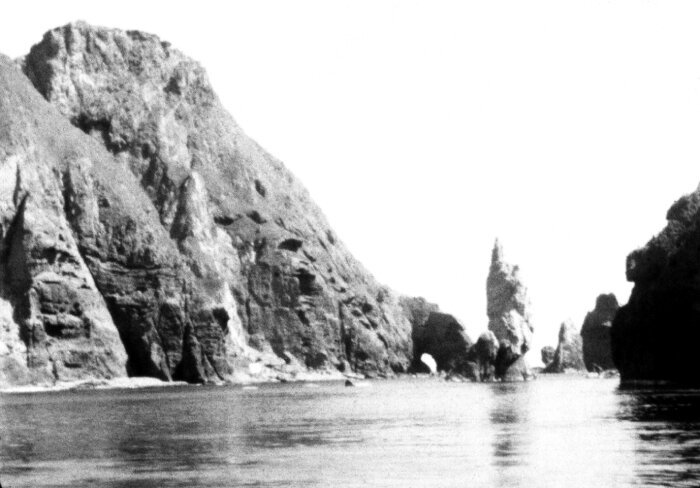
Figure 1. A view of Takeshima. At the base of Higashijima (left) are a sea arch and a narrow rocky shore. The small white dot on the shore is a media team’s tent. The rock jutting out from the sea is Kannon-iwa.
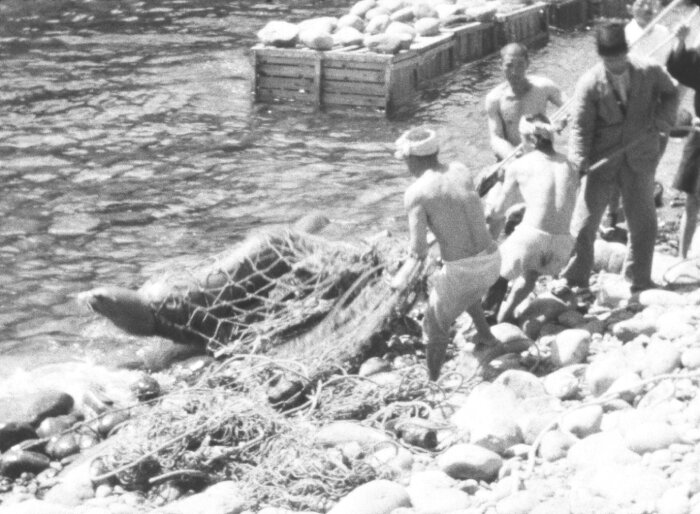
Figure 2. Sea lions that had been towed are hauled up together with the net. A sea lion cage can be seen in the upper center.
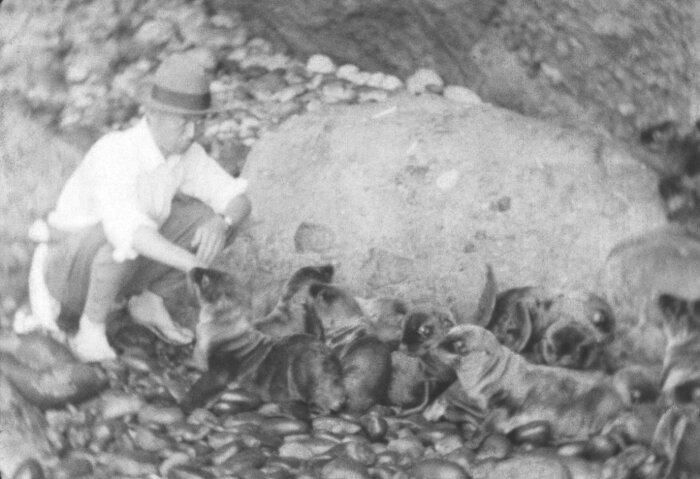
Figure 3. A group of juvenile sea lions and veterinarian Terauchi. As this was a natural group, it was not targeted for capture.
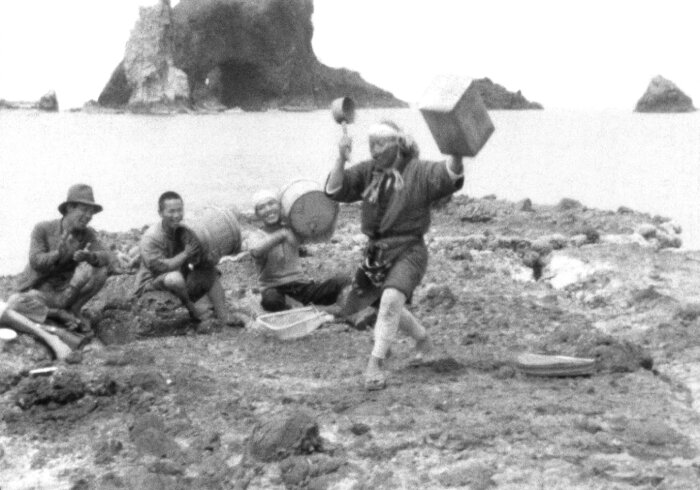
Figure 4. The hunters’ entertainment, the “Lyanko Dance.” The island visible at the top is Gotokujima.
*This article reflects the author’s personal views and does not represent the views of the Japan Institute of International Affairs (JIIA).