


- #Security
- #Americas
- #Russia, Central Asia & the Caucasus
- #China
- #Korean Peninsula
- #Middle East & Africa
- #JIIA Strategic Comments
- #Strategic Outlook 2026
Chapter 8: The Future of the Nuclear Order
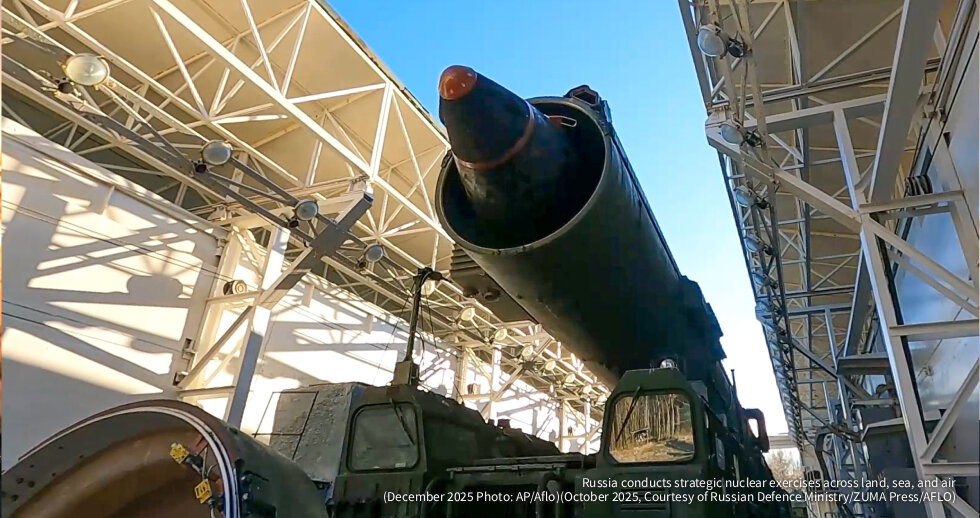

The year 2026 will likely be remembered as a decisive turning point in the postwar international security order. The New START (New Strategic Arms Reduction Treaty), the strategic nuclear arms control framework between the United States and Russia, expired on February 5, 2026, marking the onset of an arms control vacuum where no legal framework exists to limit the number of nuclear warheads or delivery systems possessed by the two major nuclear powers. Nuclear risks intensify on three fronts: Europe, East Asia, and the Middle East/South Asia. The April-May NPT Review Conference will serve as a litmus test for the international community's crisis management capabilities and its resolve to maintain the nuclear order.
Underlying tone of the US-Russia arms race
US nuclear policy could undergo a major switch in 2026. First, delays in developing the next-generation Sentinel intercontinental ballistic missile (ICBM) and building the first next-generation Columbia-class ballistic missile nuclear submarine (SSBN) as well as the lack of plutonium pit manufacturing capacity-a prerequisite for warhead modernization - have become the most significant bottlenecks in maintaining force levels. At the same time, the strategic environment underpinning the 2022 Nuclear Posture Review (NPR) has been eroded by the emergence of a dual-front threat posed by China and Russia. The pursuit of sea-launched nuclear cruise missiles (SLCM-N) and the development of the B61-13 nuclear bomb represent nothing less than a pivotal course correction for the US's nuclear posture. The United States is realigning its longstanding arms control orientation toward a new competitive strategy.
Russia's nuclear force modernization reveals a distinctly uneven composition: a stagnation in land-based forces vis-à-vis the prominence of maritime and asymmetric capabilities. The superheavy Sarmat ICBM has faced repeated deployment delays, requiring continued reliance on existing systems such as the Yars. In contrast, Borei-A-class SSBNs are smoothly entering service, forming the backbone of strategic deterrence. While the Avangard hypersonic glide vehicle (HGV) remains deployed in limited numbers, exotic weapons such as the Burevestnik nuclear-powered cruise missile and the Poseidon nuclear-powered unmanned submersible are touted primarily as tools for political intimidation, with announcements of "successful tests" preceding their practical deployment. The greatest concern is the normalization of tactical nuclear deployment in Belarus, coupled with the expiration of New START, which eliminates the guardrails provided by verification and enables the uploading of additional warheads onto existing missiles. This dramatically lowers the threshold of nuclear use in the European theater.
Escalating nuclear risks in Asia and the Middle East
In East Asia, military buildups by China, Russia, and North Korea are destabilizing the regional order.
China has moved beyond its traditional minimum deterrence posture and is approaching assured retaliatory capability that ensures mutual vulnerability with the United States. Its nuclear triad has seen dramatic enhancement: the DF-31AG and DF-41 missiles, along with large inland silo complexes, are operational; the JL-3 submarine-launched ballistic missile and the next-generation Type 096 nuclear-powered submarine are being developed; and the H-6N bomber has returned to nuclear missions. Sustaining this rapid expansion is the mass production of weapons-grade plutonium using the CFR-600 fast breeder reactor. The potential move to launch-on-warning (LOW) systems in the course of improving early warning capabilities, together with the upgrading of dual-use nuclear/conventional delivery systems such as the DF-26, heightens the risk of misperceptions and false signals during crises.
North Korea continues to expand its nuclear arsenal, estimated to hold approximately 50 warheads and nuclear material equivalent to up to 90 warheads. It expanded its first-use conditions in the 2022 Nuclear Policy Act and enshrined nuclear possession in its constitution in 2023, intensifying its shift toward high-alert operation. The diversification of delivery systems - including consecutive tests of the solid-fuel Hwasong-18 ICBM, short-range ballistic missiles, and the Pulhwasal 3-31 submarine-launched cruise missile is a concern for the alliance. While evidence of ammunition and missile transfers with Russia has been growing, the actual scope of nuclear and other advanced technology transfers remains under assessment.
The risk of nuclear proliferation is also intensifying in the Middle East. Iran's nuclear program has entered a qualitatively different danger zone following the expiration of the October 2025 deadline for the "snapback" (sanctions restoration) under UN Security Council Resolution 2231. Its stockpile of highly enriched uranium has already surpassed the quantitative threshold sufficient to produce multiple nuclear warheads, and its technical breakout time has become normalized at a state close to zero (i.e., within days). The current focus is on the gap in international monitoring caused by the loss of "knowledge continuity" (the inability to track operational status) resulting from the restart and expansion of nuclear facilities such as the Fordow Fuel Enrichment Plant (FFEP) as well as restrictions on IAEA inspections. These developments potentially provide cover for the more difficult-to-detect "weaponization" phase: designing detonators, processing metallic uranium, and adapting warheads for ballistic missiles. Iran's destabilization also carries the risk of loosening the political constraints that have kept Iran a nuclear threshold state, increasing the structural pressure that could trigger a decision to deploy operational nuclear weapons.
Entering an era of crisis management?
Under this pessimistic baseline for US-Russia relations, the expiry of arms control treaties eliminates deployment caps, inspections, and data exchange. This lack of verifiability could institutionalize mutual distrust, heightening the risks of covert arms buildups and miscalculations. To stabilize relations in the absence of legal constraints, agreement on transparency and accident prevention protocols is necessary, as is continued political restraint. Next, the 2026 NPT Review Conference can be expected to produce a lowest-common-denominator risk reduction package that would include reaffirming the non-use of nuclear weapons and the unacceptability of nuclear threats and establishing norms prohibiting attacks on nuclear facilities during wartime. Additionally, international consensus should be pursued in maintaining the Comprehensive Nuclear-Test-Ban Treaty (CTBT) regime (whose international monitoring system remains indispensable even if the treaty is not in force) and placing a moratorium on the production of fissile material for weapons (a preliminary step towards negotiating a Fissile Material Cut-off Treaty [FMCT]).
The year 2026 will likely mark a transition from an era where security was guaranteed by legally binding arms control treaties to one where crisis management takes center stage in an effort to avert catastrophe amid mutual distrust, giving rise to an uncertain "era of threat management". The instability arising from unverifiable hidden arms buildup and the intersection of new domains such as AI, cyber, and space with nuclear command, control and communications (NC3) will demand complex crisis management capabilities from national leaders. Japan, too, requires a vision and engagement to proactively address such instability.
Japan's focus in the short term will be on reflecting its interest in arms control approaches that place greater emphasis on confidence-building and crisis management in the strategic nuclear relationships among the US, Russia, and China. Recognizing the reality that the balance of power among major powers does not necessarily translate into stability or security for other nations, however, Japan will also need to devise initiatives aimed at reducing not only risks but the threats themselves over the medium to long term.
(December 26, 2025)