


JIIA Strategic Comments (2026-18) The Strait of Hormuz Crisis and Asia’s Energy Resilience ― POWERR Asia and AZEC 2.0: Japan’s New Regional Strategy —
Takio Yamada (Executive Director, JIIA Center for Global Outreach, The Japan Institute of International Affairs, Ambassador for the Asia Zero Emission Community (AZEC))

Papers in the "JIIA Strategic Commentary Series" are prepared mainly by JIIA research fellows to provide comments and policy-oriented analyses of significant international affairs issues in a readily comprehensible and timely manner.
The recent escalation of tensions in the Middle East and the disruption of shipping through the Strait of Hormuz have had profound consequences for Asian countries, most of which depend heavily on the Middle East for their energy supplies. Against this backdrop, Japan has launched the POWERR Asia (Partnership on Wide Energy and Resources Resilience Asia) initiative and announced its intention to evolve the Asia Zero Emission Community (AZEC) into “AZEC 2.0.”
This article examines the birth of POWERR Asia in response to the Strait of Hormuz crisis, the evolution of AZEC into AZEC2.0, and the strategic significance these two initiatives hold for the region and the broader international community.
Asia’s Vulnerability Exposed by the Strait of Hormuz Crisis
The recent escalation surrounding the Strait of Hormuz and the resulting disruption of shipping routes have severely affected global energy markets. Asia has been hit hardest. Approximately 90 percent of the crude oil passing through the Strait—around 13 million barrels per day—is destined for Asia, and many countries in the region remain heavily dependent on Middle Eastern energy.
For example, the Philippines relied on the Strait of Hormuz for 94 percent of its crude oil imports, while its stockpiles of crude oil and petroleum products amounted to only about 45 days of consumption when tensions intensified. Consequently, President Ferdinand Marcos Jr. declared an energy emergency on March 24, 2026.
Vietnam also depended on the Strait for 81 percent of its crude oil imports, with reserves equivalent to only about 30 days of consumption. Gasoline prices surged temporarily and have since remained volatile.
The crisis has once again underscored the reality that Asian economies remain highly dependent on energy supplies from the Middle East.
Prime Minister Takaichi Announces POWERR Asia
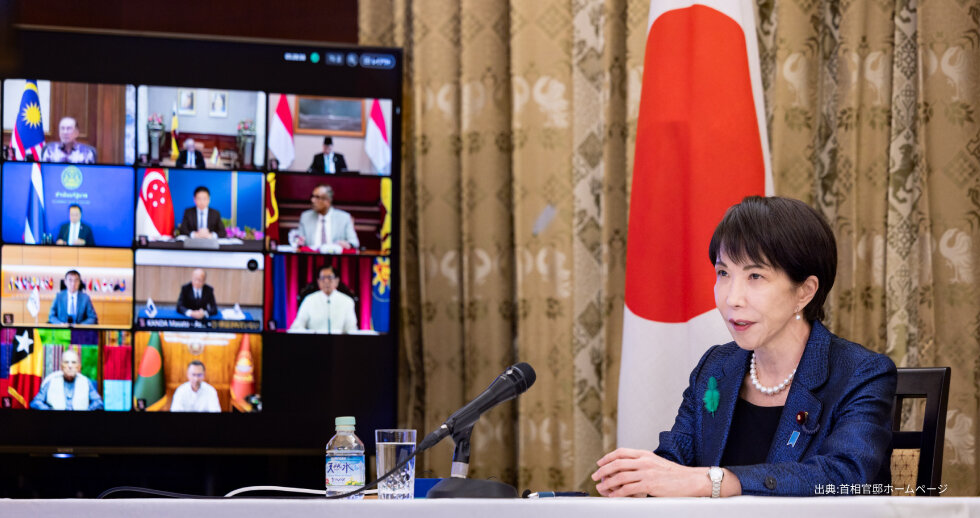
Against this backdrop, Prime Minister Sanae Takaichi convened the AZEC Plus Online Leaders’ Meeting on Energy Resilience on April 15, 2026. In addition to the eleven AZEC partner countries, leaders and representatives from five other Asian countries and the heads of three international organizations participated.
〔Reference〕Countries and Organizations Attending AZEC Plus online Summit on energy resilience
Australia*, Brunei*, Cambodia*, Indonesia*, Japan*, Laos*, Malaysia*, the Philippines*, Singapore*, Thailand*, Vietnam*, Republic of Korea, India, Bangladesh, Sri Lanka, Timor-Leste, International Energy Agency (IEA), Asian Development Bank (ADB), Economic Research Institute for ASEAN and East Asia (ERIA)
*AZEC Partner Countries
At the meeting, Prime Minister Takaichi announced the launch of POWERR Asia and declared her intention to evolve AZEC into “AZEC 2.0,” incorporating stronger economic security and energy resilience dimensions.
POWERR Asia constitutes a large-scale support package, including financial cooperation totaling US$10 billion through public financial institutions such as JBIC, NEXI, and JICA. The initiative consists of two pillars: short-term “emergency responses” and medium- to long-term “structural responses.”
Short-term emergency measures include:
• supporting the procurement of alternative crude oil and petroleum products;
• offering assistance to maintain supply chains; and
• providing financial support to affected governments.
Meanwhile, medium- and long-term structural measures include:
• establishing strategic petroleum reserve systems;
• developing storage infrastructure;
• diversifying energy sources through LNG, biofuels, next-generation solar power, and small modular reactors (SMRs); and
• promoting energy-efficiency investment and industrial upgrading.
Why Japan Supports Asia as a Whole: Energy Resilience as an International Public Good
Some may ask: “Why should Japan provide such extensive support to Asia when Japan itself faces difficulties in securing energy supplies?”
The answer is straightforward. Energy security can no longer be ensured by any single country acting alone.
Japanese companies have built production networks across Asia. If energy shortages were to disrupt operations in any part of the region, the entire supply chain—including Japan—would suffer.
This applies not only to manufacturing. In healthcare as well, Japan depends on Asian countries for products such as dialysis equipment, surgical gloves, and medical consumables. Any disruption in energy supplies within the region would inevitably affect Japanese businesses and people’s daily lives.
Energy resilience should therefore be regarded not merely as a national issue but as an international public good that underpins regional supply chains.
Energy Resilience: A New Pillar Supporting FOIP
Since its inception, the Free and Open Indo-Pacific (FOIP) vision has emphasized the rule of law, freedom of navigation, and connectivity. The recent Middle East crisis, however, has highlighted that energy resilience itself constitutes an indispensable international public good for the prosperity of the Indo-Pacific. It is increasingly emerging as a new pillar of FOIP.
This recognition was clearly articulated in Prime Minister Takaichi’s foreign policy speech on the updated FOIP, delivered at Vietnam National University in Hanoi on May 2, 2026. She declared:
“The crisis in the Strait of Hormuz is precisely a test of Japan’s determination to realize a Free and Open Indo-Pacific.”
She further announced that, as the first project under POWERR Asia, Japan would support crude oil procurement for Vietnam’s Nghi Son Refinery through NEXI.
Since then, cooperation on energy resilience has expanded rapidly across the Indo-Pacific.
During her subsequent visit to Australia, Prime Minister Takaichi and Prime Minister Anthony Albanese issued a Japan–Australia Joint Statement on Energy Security.
At the Japan–ROK summit on May 19, 2026, the two leaders committed to bilateral cooperation to strengthen energy resilience across the Indo-Pacific, including strategic stockpiles.
At the Quad Foreign Ministers’ Meeting in New Delhi, the four countries issued a Joint Statement on Indo-Pacific Energy Security.
During President Marcos Jr.’s visit to Japan, Prime Minister Takaichi announced support for strengthening the Philippines’ national reserves and for an ASEAN joint stockpiling initiative.
Moreover, the concept of energy resilience championed by POWERR Asia is expanding beyond the Indo-Pacific to Europe and the G7.
During Prime Minister Takaichi’s visit to the United Kingdom on June 14, 2026, Japan and the UK issued a leaders’ declaration on economic security that included cooperation on stable energy supplies.
At the G7 Evian Summit held shortly thereafter, Prime Minister Takaichi promoted the principles underpinning POWERR Asia to the international community. She called for resisting unjustified export restrictions, supporting efforts to augment strategic petroleum reserves, and enhancing dialogue and cooperation between energy-producing and energy-consuming countries.
The Significance of AZEC 2.0
Launched in 2022, the Asia Zero Emission Community (AZEC) was conceived as a framework for regional cooperation that seeks to achieve three objectives simultaneously—decarbonization, economic growth, and energy security—while taking into account Asia’s reality of rapid economic growth and continued dependence on fossil fuels.
Three AZEC Leaders’ Meetings have been held to date, generating approximately 540 cooperation projects.
In the wake of the Strait of Hormuz crisis, which exposed the vulnerability of Asia’s energy supply systems, AZEC is evolving into AZEC 2.0, a more comprehensive framework that more deeply integrates economic security and energy resilience perspectivesand seeks to advance climate action while enhancing energy resilience.
Even before the crisis, AZEC had endorsed many of the structural measures envisaged under POWERR Asia, including diversification of energy sources through LNG, biofuels, next-generation solar technologies, and SMRs, as well as energy-efficiency investment and industrial upgrading.
While these initiatives were originally driven primarily by climate objectives, the energy shortages triggered by the Strait of Hormuz crisis have led to a renewed appreciation of their value from the perspective of energy resilience.
The AZEC Ministerial Meeting in September and the AZEC Leaders’ Meeting in November, both to be held in the Philippines, are expected to deliver concrete outcomes demonstrating the evolution toward AZEC 2.0.
Japan Supporting Asia’s Energy Resilience
In recent years, Japan has played a leading role in regional cooperation through initiatives such as FOIP and the CPTPP.
As the Strait of Hormuz crisis brought energy resilience to the forefront as an urgent challenge for Asia, Japan moved swiftly to launch POWERR Asia and AZEC 2.0. By leveraging its financial resources, technological capabilities, and institution-building expertise, Japan has demonstrated—both domestically and internationally—its determination to play a central role in enhancing energy resilience as an international public good.
POWERR Asia and AZEC 2.0 have also become new strategic foundations underpinning the updated FOIP.
Although the peace agreement between the United States and Iran is expected to ease tensions surrounding the Strait of Hormuz, questions remain regarding implementation and other aspects of the agreement, and geopolitical risks in the Middle East have by no means disappeared. For the countries of the Indo-Pacific, therefore, the importance of enhancing energy resilience is unlikely to diminish in the years ahead.
As geopolitical and economic security risks increase uncertainty not only in the Indo-Pacific but also around the world, countries are increasingly called upon to overcome division, deepen cooperation, and act responsibly in concert.
POWERR Asia and AZEC 2.0 embody Japan’s commitment to working with regional partners to address common challenges. As new flagship initiatives symbolizing Japan’s contribution to the international community, their strategic significance is likely to grow even further in the years ahead.